Best Mountain Bike Derailleurs
- Best Overall Performance: Shimano Deore XT RD-M786 SGS Shadow Plus
- Best All-Terrain: SRAM NX Eagle
- Best Value for Money: Shimano RD-M640 Zee Shadow Plus
- Best Budget Option: Inkesky Shimano RD-TZ31-A
- Best for Casual Riders: Shimano Acera M360
- Best Entry-Level: Thalous Tourney RD-TY21B Rear Derailleur
- Best for City-Riding: Shimano Altus RDM310
- Best for Long-Term Use: Microshift Advent
- Best Off-Road: SRAM NX 1X11 X-Horizon
- Best Upgrade: Shimano DEORE XT RD-M8000
The best mountain bike derailleurs can change your ride by solving common issues like gear slippage, noisy shifts, and poor performance on tough trails.
If you are an urban or suburban cyclist, you know that a smooth, reliable bike makes every ride more fun and safe.
When looking for rear derailleurs, we are usually concerned with durability, performance, and price. This is also the case when looking for the best internal gear hubs.
The durability of derailleurs is usually dictated by the materials used to manufacture them. That’s why more expensive derailleurs tend to be sturdier.
Need a Few Practical Extras for Your Next Ride?
Browse cycling-related clothing and simple bike accessories that may help with comfort, visibility, storage, or everyday riding.
Paid links. As an Amazon Associate we earn from qualifying purchases.
On the other hand, the quality of performance is influenced by both the material and the details of the derailleur. The finer the make of every small part of the derailleur, the better its performance will be.
The best derailleurs regarding performance in relation to price are SRAM and Shimano.
We understand that you look for quality, easy-to-use gear that lasts long and fits your busy life.
In this guide, we break down the top picks, give expert tips, and share real insights to help you make the best choice without feeling pushed to buy.

12,713
Customer Reviews

14
Testing Hours

10
Tested Products

13
Sources Researched
- Best Mountain Bike Derailleurs
- 10 of the Best Mountain Bike Derailleurs
- Best Overall Performance: Shimano Deore XT RD-M786 SGS Shadow Plus
- Best All-Terrain: SRAM NX Eagle
- Best Value for Money: Shimano RD-M640 Zee Shadow Plus
- Best Budget Option: Inkesky Shimano RD-TZ31-A
- Best for Casual Riders: Shimano Acera M360
- Best Entry-Level: Thalous Tourney RD-TY21B Rear Derailleur
- Best for City-Riding: Shimano Altus RDM310
- Best for Long-Term Use: Microshift Advent
- Best Off-Road: SRAM NX 1X11 X-Horizon
- Best Upgrade: Shimano DEORE XT RD-M8000
- Front vs. Rear Derailleur
- What to Look for When Buying Mountain Bike Derailleurs
- Installation and Adjustment
- Most Commonly Asked Questions
- Conclusion: The Best Mountain Bike Derailleurs
10 of the Best Mountain Bike Derailleurs
Best Overall Performance: Shimano Deore XT RD-M786 SGS Shadow Plus

- Conventional/Standard Mount Attachment
- 10 Speeds
- Largest Sprocket 36T
- Smallest Sprocket 11T
- Total Capacity of 43T
- Maximum Front Capacity 22T
- Pulley Teeth 11T
- SGS Pulley Cage
- Sealed Bearing
- Stabilizer Switch
Light, simple, precise, reliable, and durable. These five words summarize the qualities of the Shimano Deore bike derailleur.
This derailleur exemplifies the term “smooth shifting.” With the new Shimano clutch technology, you can increase spring tension with a switch. This makes shifting simpler, stabler, and quieter.
Also, this derailleur prevents the chain from bouncing or slapping on the sprocket, even on rocky and muddy trails. This ensures reliable shifting regardless of the terrain.
With a maximum chain wrap capacity of 43T, the Shimano Deore XT RD-M786 can accommodate a wide gear options. With this much range, you can have a breezy ride on flats as well as a comfortable climb on hills.
This model is a great match if you ride on varied terrains. It helps keep your chain steady and quiet. Many riders find that its smooth shifting makes climbs and flats easier, which is very helpful if you are riding in the city or on rough trails.
Best All-Terrain: SRAM NX Eagle

- Standard Mount Type
- 12 Speeds
- Long Cage
- 14T X-Sync Lower Pulley
- 10-50T or 11-50T Cassette Capacity
- X-Actuation and Type-3 Roller Bearing Clutch
- With Cage Lock Button
- Steel Cage Lock
Do you love exploring new paths? The SRAM NX Eagle is built for riders who seek adventure. It offers precise shifting and quiet gear changes. Its sturdy design is ideal if you ride on mixed surfaces.
This derailleur is built with the same X-horizon design and X-sync pulley that the SRAM NX eagle 11-speed has. With SRAM technology, shifting is consistent and precise.
Moreover, the X-actuation and Type-3 roller bearing clutch eliminate chain slap. This results in quiet and smooth gear changes.
As with its 11-speed counterpart, this derailleur is also made of steel. It is a bit heavier but long-lasting. With the average user, this derailleur can outlast the lifespan of all the components of the mountain bike.
Try this derailleur if you face bumpy rides and need a system that prevents chain slapping. It gives you the freedom to enjoy your ride without extra noise or stress.
Best Value for Money: Shimano RD-M640 Zee Shadow Plus

- 10 Speeds
- Short Cage
- 11T Guide Pulley
- Largest Sprocket 36T
- Smallest Sprocket 11T
- Total Capacity 25T
- Single Maximum Chainring Difference
- Aluminum Construction with Sealed Bearing Pulleys
The Shimano RD-M640 derailleur offers a sleek design that minimizes noise and keeps the chain secure. Its low-profile shape helps avoid contact with the chainstay. It also has a chain tensioning device. This device minimizes noise in the drivetrain. It also prevents chains from dropping during gear shifts.
Shifting is crisp and reliable, with no chain bounce or slap against the sprocket, even on rough terrain.
This derailleur has a total capacity of 25T with a single maximum chainring difference. This gear option is more than enough for an average rider and sufficiently wide for the adventurer.
This derailleur is a good pick if you want quality without a high price. It is tested to work well even in rough conditions. Many riders appreciate that it handles everyday use with ease.
Best Budget Option: Inkesky Shimano RD-TZ31-A
No products found.
The Shimano RD-TZ31-A is simple to install with clear adjustment screws and accessible parts.
Indexing the gears is also easy. The location of the H and I screws is accessible, and adjusting it does not take a lot of effort.
This derailleur is made of aluminum alloy, making it lighter than derailleurs made of steel. The lightness, however, does not affect its durability as it can still withstand short rides on the hard trail.
With its medium cage length, it can accommodate a wide gear option sufficient to make your daily riding smooth and comfortable.
This model is perfect if you are new to biking or on a tight budget. It is light and works well on regular rides, making it a smart choice for everyday cycling in the city.
Best for Casual Riders: Shimano Acera M360

- SGS Long Cage design
- Compatible with 7/8 speed chain
- Total Capacity of 34T
- Largest Cog 34T
- Smallest Cog 11T
- Oversized 13-tooth pulleys
- Aluminum and Steel Construction
If you enjoy daily rides without tough off-road challenges, this derailleur suits your needs. It supports a wide range of gears for gentle hills and city roads.
The Shimano Acera M360 comes with a cage that can accommodate a wider gear option. It is compatible with 8- speed HG sprockets. With this many gear options, you can climb hills effortlessly.
It is made of aluminum and steel to save on weight without compromising durability.
Its design offers smooth and reliable shifting even under heavy load. Gear change during acceleration is also quick and precise.
Best of all, the oversized pulleys help reduce rubbing between the chain and the sprocket. This results in a more precise shifting response. Casual riders often need a system that works seamlessly in traffic and on well-paved roads. The Shimano Acera M360 delivers smooth, reliable shifting that makes your commute stress-free.
Best Entry-Level: Thalous Tourney RD-TY21B Rear Derailleur
No products found.
The THALOUS Bicycle Rear Derailleur Tourney RD-TY21B is a reliable choice if you’re looking for a quality derailleur that won’t break the bank. Crafted from durable aluminum alloy, it stands up well to everyday riding conditions without losing its shape.
If your bike uses a hanger mount system, this model offers an excellent blend of performance and value. Its medium cage design and compatibility with 6/7-speed setups ensure smooth gear transitions, whether you’re navigating city streets or tackling light trails.
The derailleur’s total capacity of 34T and sprocket range from 14T to 28T give you the flexibility to handle various gear ratios, making your ride more efficient and enjoyable.
This derailleur is especially well-suited for riders who need a dependable component for daily commuting or casual off-road adventures. Its straightforward installation and robust construction make it a user-friendly option for those who prefer simplicity and durability in their bike’s drivetrain.
Best for City-Riding: Shimano Altus RDM310

- Short Cage
- Compatible with 7/8 Speed
- Chain Wrap Capacity 43T
- Derailleur Action: Top-Normal (Traditional)
- Maximum Rear Cog 34
- Largest cassette 32T
- Smallest cassette 11T
- Oversized 13T Top pulley and 15T bottom pulley
- Metal Material
The Shimano Altus mountain bike derailleur is built for urban riding. It installs easily and promises both durability and quick gear shifts on city roads.
It is made of solid metal, which makes it sturdy. It can withstand a tremendous amount of external force without getting damaged.
The shifting movement is fast and accurate. There is no delay in transmission during gear shifts.
The total capacity is wide enough to accommodate sufficient number of gears for a good ride around the city. Although it is best for general road rides, it can also handle many patchy and uphill roads.
If you face frequent stop-and-go traffic, this derailleur provides fast, accurate shifts to match your pace. It works well on both smooth roads and bumpy by-lanes, ensuring a comfortable ride.
Best for Long-Term Use: Microshift Advent

- Compatible with 9 speeds
- Medium Cage
- Chain Wrap Capacity 41T
- Largest Cog 46T
- Smallest Cog 11T
- Steel Cage with Aluminum Outer
- With Clutch
- Direct Path Cable Routing
This mountain bike derailleur is sleek and resilient like a diamond. It is built like a tank. It is durable and designed to handle many miles on tough trails.
With a steel cage and an aluminum outer, the advent exhibits sturdiness comparable to that of a tank without being overly heavy.
It comes with a clutch that helps maintain chain tautness over uneven terrain. The mechanics of the derailleur is designed to provide a more direct cable path. This makes the changing of gears from the lowest to the highest gears feel stable. Adjustment and indexing may take quite a bit of effort if you are not familiar with the process.
With regular use, this easy-to-install Microshift Advent may last you a lifetime.
Best Off-Road: SRAM NX 1X11 X-Horizon
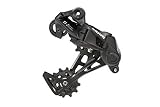
- Compatible with 11 Speed 1x Drivetrains
- Long Cage
- X-Actuation Cable Pull Ratio
- 12T X-Sync Pulley Wheels
- Largest Sprocket 42T
- With Roller Bearing Clutch
- With Cage Lock
- Steel Cage Material
- Steel Pulley Bearings Material
Heavy-duty and precise. The SRAM NX 1×11 caters to the needs of trail lovers. Its steel design and advanced shifting technology make it a strong choice for off-road adventures.
This derailleur is made of steel which ensures maximum resistance against external damage. It also comes with a steel cage that protects the derailleur during installation and wheel removal.
SRAM’s X-horizon design ensures faster and accurate shifting. This technology, present in the NX Eagle 11, keeps the movement of the chain on the horizontal axis. This decreases the shifting force and prevents ghost shifting.
In addition to the X-Horizon technology, this derailleur is also equipped with a roller-bearing clutch. This clutch prevents the chain from rebounding resulting in a quieter and more stable drivetrain.
If you ride on rocky paths and steep trails, this derailleur can reduce ghost shifting and chain bounce. Its sturdy build means it handles rough terrain with ease.
Best Upgrade: Shimano DEORE XT RD-M8000
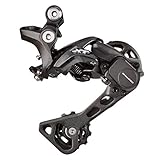
- Conventional Mount Attachment
- 11 Speed
- GS Pulley Cage
- Total Capacity 39T
- Largest Sprocket 42T(2x11s)/46T(1x11s)
- Smallest Sprocket 11T
- Pulley Teeth 11T
- Maximum Front Difference of 10T
- Sealed Bearing
Are you tired of flat roads and small hills? This Shimano DEORE XT upgrade is made for riders who want a change.
This masterpiece from Shimano is made of high-quality aluminum alloy. This makes it lighter and durable at the same time.
It also comes with a chain stabilizer. When the stabilizer switch is engaged, the spring tension is increased. This results in a lesser chain slap. It also prevents chains from dropping when changing gears.
With fewer slaps and gear drops, shifting becomes faster and more accurate. The drivetrain also becomes quieter as the chain does not grind against the cassette.
The Shimano Deore XT RD M-8000 has a sufficient number of gears for mountain biking on steep and rocky terrain.
This derailleur offers faster, more accurate shifts and a quieter ride. It is built to handle rough mountain terrain and is tested to perform over thousands of miles.
Front vs. Rear Derailleur
A derailleur is that part of the bike responsible for moving the chains from one sprocket to another. Most mountain bikes have two derailleurs: front and rear derailleurs. The front sprocket is also called a chainring, while a rear sprocket, a cog.
- Front Derailleur: Moves the chain between the chainrings.
- Rear Derailleur: Keeps the chain tight and shifts gears in the back.
The front derailleur guides the chain from one front sprocket to another. This happens when you pull on the left shifter.
Meanwhile, the rear derailleur has two main functions: First, to keep the chains tense; and, Second, to switch gears. The right shifter moves the chains in the rear cassette sprocket.
A rear derailleur is necessary for all mountain bikes unless: (1) The mountain bike has an internal gear hub; or (2) The mountain bike has a single speed. On the other hand, a front derailleur is present in all mountain bikes except in 1by mountain bikes.
The front derailleur switches gears by moving the top of the chain under chain tension while you are pedaling. On the other hand, the rear derailleur switches gears by moving the bottom chain from side to side.
Important: If your bike has only one gear or uses an internal hub, you may not need a rear derailleur. Choose the right type based on your riding style and bike setup.
What to Look for When Buying Mountain Bike Derailleurs
Gear Ratios
The gear ratio is determined by dividing the teeth count of the cog with the teeth count of the chainring. The resulting quotient or the gear ratio indicates the number of times the wheel will turn for every rotation of the pedals.
The relationship of the derailleur with the gear ratio has something to do with the total tooth capacity of the bike derailleur.
A derailleur’s total tooth capacity is calculated this way:
(largest cog-smallest cog) + (largest chainring-smallest chainring) = Total Tooth Capacity
The total tooth capacity determines the gear range that your rear derailleur can handle. If it can accommodate a higher number of gear, it gives you more precise shifting options. With more options, you can have better gear ratios. This will ultimately make you’re pedaling easier without compromising your speed.
Always choose your bike derailleur based on the number of speeds your mountain bike has. That is the number of cogs in your rear cassette sprocket multiplied by the number of chainrings your crankset has.
Look for a derailleur that offers the right range of gears. More gears mean easier climbs and faster flats.
Cage Length
Rear derailleurs have three cage length: (1) short, (2) medium, and (3) long. Longer cages work best on rough trails; shorter ones are great for city riding.
The cage length dictates the range of gears that you can have on your bike. Shifting gears requires the movement of the chain from one cog to another. If the cage is longer, there is a greater slack chain created when you shift gears.
The cage length is dictated by the distance between the upper and lower pulley of the derailleur.
Generally, mountain bikes with wide gear ratios should go with medium or long cage bike derailleurs. Road bikes with double chainrings, on the other hand, usually go with short cage bike derailleurs.
When deciding the appropriate cage lengths for bike derailleurs, keep the following things in mind:
1. Choose a derailleur that belongs to your mountain bike groupsets;
2. If you can’t find one from the same group set, check the tooth capacity and ensure it matches your drivetrain; and
3. If all else fails, you can consult a bike shop for professional advice.
Weight
The weight of a derailleur is primarily dependent on the material used to make it. Steel, aluminum, carbon, or titanium are the most commonly used materials to build a derailleur. Some bike derailleurs have components made from a combination of these elements or alloys.
Carbon is, without a doubt, the lightest, while steel is the heaviest. But, what steel lacks in the weight division, it compensates in durability.
When deciding on the weight of the derailleur you are going to buy, you need to consider the following:
1. The terrain where you wish to bike;
2. Your purpose for mountain biking; and
3. Your budget.
The terrain where you wish to ride your mountain bike and your purpose for mountain biking determine whether you should focus more on durability or lightness. If you are into uphill riding, you might want to sacrifice a bit of durability for lightness. However, if you are into technical trails, you should be more concerned about durability over lightness.
Another area of concern is your budget. Lighter and sturdier mountain bike derailleurs are generally more expensive. This is due to the materials used in manufacturing it. A combination of materials makes up some derailleurs. This is to maintain the derailleur’s lightness without sacrificing sturdiness. These mountain bike derailleurs can be on the expensive side.
Lighter derailleurs are easier to handle but might be less durable. Balance your need for speed with the strength of the material.
Compatibility
The general rule is that you should not mix and match drivetrain components from mountain bike groupsets and brands.
If your drivetrain is Shimano, stick with Shimano parts throughout to avoid any compatibility issues.
However, if it is impossible to find your bike derailleur’s brand model, you must research first.
Check the product details of the new derailleur you are planning to install. See to it that it matches your drivetrain gears. Next, check if the cable pull is the same as your old derailleur. If not, look if there are available cable pull converters.
If you find a bike derailleur that you think would fit but you still feel unsure about it, consult your nearest bike shop.
Make sure your new derailleur matches your bike’s drivetrain. Stick to the same brand if possible to avoid issues.
Clutches
The clutch in a derailleur provides tension to keep the chain in place. Without tension, the chain would fall off the chainrings. This is especially true when you are mountain biking on any terrain.
In mountain bike derailleurs without a clutch, the tension is provided by the main pivot. With the clutch, resistance is increased, and shifting becomes quieter and more reliable.
The main pivot provides sufficient tension in rear derailleurs without a clutch. So having a clutch derailleur is not a “must” but more of a “recommended” thing.
A clutch helps keep your chain in place. It is important for riders who hit bumpy roads or rough terrain.

Installation and Adjustment
Installation
Installing your rear derailleur on your mountain bike requires the following tools:
- Allen Key
- Torque wrench
- Phillips screwdriver
- Bike stand
After preparing the tools you need, the next thing to do is remove your old rear derailleur. You do this by shifting your chain and moving it to the smallest cog in your sprocket. After that, pull off the end cap, unfasten the cable pinch bolt and detach the cable from the derailleur. Then, remove the chain from the rear derailleur.
Removing the chain requires disconnecting a link. This is where you may need a chain remover.
After unlinking your chain, remove the lower jockey key. Then, rotate the cage plate to release the chain.
The last step of removal is to unscrew your derailleurs’ mounting bolt counterclockwise. After this, you can remove the old derailleur and start installing the new derailleur.
Check if your new derailleur is a standard or direct-mount derailleur. If your old derailleur was a standard mount one and the new derailleur is direct, you might need to replace your derailleur hanger.
Before placing your bike derailleur, you will need to put waterproof grease on the mounting bolt. Then you thread the rear derailleur halfway to the derailleur hanger, turn it clockwise, and fully tighten the mounting bolt.
The next thing to do is to insert the shift cable into the derailleur. Pull the derailleur to straighten it. Make sure it has no slack. You can then adjust the cable by loosening and re-tightening it.
Summary:
- Use basic tools like an Allen key and a screwdriver.
- Shift your chain to the smallest cog and remove the old derailleur.
- Install the new one with a bit of waterproof grease.
- Follow the instructions closely, or check a simple video online if you get stuck.
Adjustment
If your bike has multiple chainrings, move the pedal and shift to the largest chainring in the front. Then, move the chain to the lowest cog in the rear.
Adjusting the B-tension screw is the first thing to do. The B-tension screw moves the guide pulley up and down, moving it closer or farther from the cassette.
When you turn the B-tension screw clockwise, the guide pulley moves farther from the sprocket. Turning it the other way moves the guide pulley closer to the cassette.
Adjust the B-tension screw until you see that the chain does not scrape the sprocket when you pedal the bike forward and backward.
Indexing your gears means moving the chain from one cog to another while you move the pedal. You do this to prevent your chain from getting and skipping when you change gears.
Indexing requires listening for any clicking or rubbing sound as you turn the pedals. You do this for every gear.
If you hear any clicking or rubbing sound, check if the chain is rubbing the gear above or below it. If it does, turn the barrel adjuster clockwise. Make small adjustments and check their effect. If there is no sound, then the adjustment is right. Move the chains to the next gear and repeat the same thing.
Summary:
- Shift to the largest gear at the front and smallest at the back.
- Adjust the B-tension screw to keep the chain clear of the gears.
- Listen for clicks or rubs. Small tweaks help your gears shift smoothly.
Most Commonly Asked Questions
Conclusion: The Best Mountain Bike Derailleurs
There are a lot of bike parts manufacturers nowadays that produce rear derailleurs. It would be impossible for a single ordinary rider to have the chance to test them all before buying one.
But here are a few things to remember when deciding on the rear derailleur you want to buy:
(a) It is always best to buy from an established brand like Shimano and SRAM;
(b) Always check for compatibility issues with your current drivetrain; and
(c) Read on the rear derailleur features to check if it fits the kind of mountain biking and the type of terrain you like.
Issues on installation and indexing can come after. You can usually solve these problems with a YouTube video or a quick visit to your local shop. With these said, Shimano Deore XT RD-M786 SGS Shadow Plus Rear Derailleur is the best mountain bike derailleur for its superb performance.
Have a fun ride!
Consider the following mountain bike upgrades, too: