Best Bike Brakes
- Best Overall: Hope Tech 4 E4
- Best Value Road Calipers: SRAM Force Brake Caliper
- Best for All-Mountain Hydraulics: Shimano M820 Saint
- Best Budget Mechanical Disc for Downhill Rides: BlueSunshine BB7
- Best Cyclocross: Avid Shorty Ultimate Cantilever Brake
- Best Entry-Level Hydraulic: JGbike Shimano MT200
- Best Budget Hydraulic: Clark’s Cable Systems M2 Brake
- Best for Extreme Riding: Sram Code RSC
Best bike brakes can make or break your ride—literally. If you want to stay safe on every twist and turn, you need reliable braking power that matches your riding style. When faced with terms like “dual-pivot,” “hydraulic,” or “rotor size,” you might feel overwhelmed and unsure where to start.
We all know that having the best brakes for your bike is essential, but there are so many options, and it’s hard to choose.
If you want to be safe when riding your bike, you need a great set of brakes. But how do you find the right ones? What should they look like? How much should they cost? Which brand is best? And what about disc vs. rim brakes? It’s enough to make anyone throw their hands up in frustration!
The good news is we’ve done the research for you and created this guide on how to buy bike brakes. You’ll learn which features matter most, how much each type costs, and even get recommendations on some of our favorite models currently available today. Let’s get started!
Need a Few Practical Extras for Your Next Ride?
Browse cycling-related clothing and simple bike accessories that may help with comfort, visibility, storage, or everyday riding.
Paid links. As an Amazon Associate we earn from qualifying purchases.
Read also our reviews on the best mountain bike brakes and best road bike brake pads.

19,554
Customer Reviews
16
Testing Hours

8
Tested Products

15
Sources Researched
8 of the Best Bike Brakes
Hope Tech 4 E4
Best Overall: Premium four-piston control for every trail

- Four-piston caliper
- Machined-from-billet alloy construction
- Sealed bearing pivots at the lever
- Tool-free reach and contact adjustment
- Compatible with 160–203 mm rotors
Hope Tech 4 E4 is built for riders who want top-notch modulation, power, and durability across any terrain. Its four-piston design delivers smooth, balanced braking force whether you’re charging steep descents or navigating tight switchbacks.
The billet-alloy caliper and lever bodies not only reduce weight but also resist flex under load—so braking remains consistent lap after lap.
Sealed bearings at the lever pivot keep mud and grit out, ensuring a crisp lever feel even in sloppy conditions. You can fine-tune lever reach and pad contact without tools, so once it’s dialed in, you won’t need to fuss in the field.
Overall, if you plan to push your limits—be it enduro, all-mountain, or downhill—Hope Tech 4 E4’s combination of raw power and precise control makes it our new Best Overall pick.
SRAM Force Brake Caliper
Best Value Road Calipers: Reliable modulation at a midrange price

- Rim dual-pivot rim brake design
- Reach: 39-49mm
- Titanium pivot bolts and cold-forged arms
- SwissStop Black Prince pads included
- Quick-release lever
SRAM Force blends affordability and performance for road riders who want consistent stopping power without spending a small fortune. The dual-pivot layout provides strong braking force and predictable modulation, and the titanium bolts keep weight in check. An expanded tire clearance (up to 28 c) means you can run wider, more comfortable tires without rubbing.
Furthermore, SRAM Force has a finishing that matches the wireless Force eTap AXS groups. So if you have this gear already, you might as well check the Force brake. The quick-release system also allows easy wheel detachment on emergency repairs. And you also get SwissStop pads.
SRAM Force is best for its reliable performance, durable build, and easy wheel detachment in terms of value. It also has a SwissStop Black Prince brake pad that provides greater stopping power and resistance to fading. Best of all, Force is affordable for most riders.
Shimano M820 Saint
Best All-Mountain Hydraulics: Exceptional heat management and bite

- Four-piston ceramic calipers (Ice-Tech)
- Servo-Wave lever technology for quick pad engagement
- Pre-bled with one-way bleeding ports
- I-Spec II compatibility for clean cockpit setup
- Includes HPC resin or sintered pads
Shimano Saint takes pride in its ceramic 4-piston calipers. This assures high power braking force, especially on gravity or downhill rides. It also has Ice technologies integrated, so you can expect better heat management. As a result, there is minimal pad wearing while giving a remarkable modulation.
Saint also features Servo-Wave levers that give best control and ergonomics. Due to its hydraulic nature, Shimano M820 doesn’t require much effort in actuating the brake. This best works when shifting gears to avoid interference between levers and switches.
Shimano Saint also offers a one-way bleeding caliper, so bleeding when needed is a lot easier and cleaner. The ergonomic Servo-wave levers allow tool-free reach adjustments and quick stroke tuning so you can enjoy better and smooth control of your ride.
Saint is best for an all-mountain type of ride. Shimano M820 best works well when descending and climbing.
BlueSunshine BB7
Best Budget Mechanical Disc for Downhill: Easy setup and dependable power
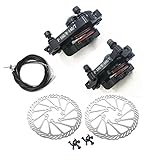
- Dual-sided mechanical disc design (fits 160 mm rotors)
- Aluminum alloy calipers with stainless steel hardware
- Linear-pull-compatible lever interface
- Adjustable pad tension knob for fine-tuning
Smooth and easy power adjustment plus excellent stopping power is what you will get with Blue Sunshine. Brake cables, 12 bolts, and another two sets of stainless steel rotors also fit the linear-pull brake levers. Plus, you get a fully-loaded kit that includes two sets of aluminum alloy calipers for your front and back wheels.
Installing the brake is quick and easy, so you won’t spend much of your time setting it up. Once complete, you can now enjoy a solid brake that lasts for longer bike rides.
The descending capacity of the rotors is tremendous even in wet conditions downhill. It best works with high-performance bikes and is best for technical descents.
BlueSunshine best suits riders who want excellent stopping power and smooth control of their ride.
Avid Shorty Ultimate Cantilever Brake
Best Cyclocross: Outstanding modulation and mud clearance

- Symmetrical dual-pivot cantilever design
- Fits a wide variety of tire sizes (700×28c+)
- Lightweight aluminum arms with SwissStop Compound pads
- Center-pull cable routing for consistent pull
- Quick-release cable mechanism
If you love the adventures of cyclo-cross racing, Avid Shorty Ultimate brake is an excellent choice. It is generally lightweight aluminum fitted with SwissStop Compound pads, so you are assured of heavy-duty braking power.
The high-arch design also allows a wide range of fitting to tires and wheels. With its symmetrical dual-pivot design, the right pressure is applied on the rim for best braking performance.
The center-pull design fits better on a short-pull drop bar road or mountain levers. With its quick-release cable and fork post mounting, you will appreciate this brake’s easy installation and adjustments.
JGbike Shimano MT200
Best Entry-Level Hydraulic: A decent brake system for starters
No products found.
The JGbike Shimano MT200 hydraulic disc brake comes with a setting already adjusted for starters. Don’t worry if you have smaller hands because it offers a minimum reach of 75 mm. The 3-finger lever on the left side is built from rigid steel. The master cylinder, on the other hand, is made out of painted aluminum, so you can depend on its durability.
JG Shimano is a fit for almost any electric or mountain bike. MT200 fits with rear 160 and front 180mm rotors. An additional bracket can also accommodate 203mm rotors; mind you, this is not common to hydraulic brakes.
Its resin-made dual-piston plus pre-bled mineral ensures consistent deceleration and control when stopping.
Another feature of JG MT200 is its capacity to distribute high heat without damaging the brake and tires, so you don’t need to change often. Fewer cables are also used, giving you more space on the handlebars for other accessories.
For those who want a solid yet novice-friendly braking system, JG Shimano best serves the role. It is best for anyone who wants to add stopping power to their bike.
Clark’s Cable Systems M2 Brake
Best Budget Hydraulic: Affordable modulation for light XC and commuting

- Two-piston twin-caliper hydraulic design
- Pre-filled with mineral oil; easy pad changes
- Fits 160 mm rotors; Shimano pad-swap compatibility
- Tool-free lever reach adjuster for small or large hands
- Aluminum master cylinder with anti-rust finish
Great control and reliability at a price that won’t bleed your wallet: that is what Clark M2 offers. The twin-piston calipers, together with their sleek lever design, deliver outstanding modulation, whether in dry or wet conditions.
The levers have an evident squeeze and a sturdy feel when decelerating. This is a plus, especially on XC riding.
The master cylinder is made of aluminum alloy, which has an anti-rust finish. It best fits 160 mm rotors.
Clark M2 has a modern finishing, so installation is simple and tool-free. Since it is almost identical to Shimano Deore, you can replace the brake pads with Shimano pads when needing to change.
The best part about Clark M2 is that it best fits almost any road bike, regardless of the type of brake levers, so you can optimize other accessories on your handlebars.
Sram Code RSC
Best for Extreme Riding: Unmatched power and heat management

- Four-piston “Oversized” caliper for maximum bite
- Enlarged fluid reservoir for consistent lever feel
- Sealed cartridge bearings at the lever pivot (less finger fatigue)
- Designed for 180 mm–203 mm rotors
- Tool-free reach and pad contact adjustments
When gravity is your co-pilot, SRAM Code RSC delivers the braking authority you need. Oversized pistons and a beefy fluid reservoir keep your lever feel firm, even on the longest descents. Reach adjustment is tool-free, so you can set finger position exactly where you like—no foreshadowed finger fatigue on multi-hour rides.
Pair Code RSC with large rotors, and you’ll see nearly zero fade on big mountain days. Its sealed bearings at the lever pivot maintain silky-smooth lever action, which translates to more predictable braking when you’re already pinned on a steep pitch. If you ride park laps, enduro stages, or any ride where stopping fast is critical, Code RSC’s melee of raw power and precise heat control makes it our top pick for extreme use.
SRAM Code best serves for XC, AM, and DH trails.

Types of Bike Brakes
Rim Brakes
The rim brake is the traditional brake that clamps onto the wheel rim to prevent it from rotating or slowing it down. The rim brakes are cast iron, stainless steel alloy (normally chromium-vanadium steel), titanium, and carbon fiber. It consists of a metal rim band, caliper, and brake pads.
Cyclists who want rim brakes for their mountain bikes, hybrid bikes, or any other bicycle should understand the advantages and disadvantages of rim brakes before they buy rim brakes. The rim-type brake has many advantages over disc brakes.
Rim brakes can easily last years, while some bicycles use a disc brake for the braking system.
Studies show that rim brakes can offer lighter weight and simpler maintenance, but they perform poorly in wet conditions compared to disc brakes. Brake pad design—like narrower grooves—can improve rim brake performance by up to 64 % in simulations (Keong & Teoh, 2018).
Disc Brakes
The disc brake is a bicycle brake system designed to stop the wheel by using friction. Proper disc brakes will have a large diameter disc with a small hydraulic/cable actuation caliper attached for less rotational weight. The disc is usually cast iron or ceramic and mounted on the wheel hub behind the spokes.
Mechanical disc brakes are the most basic type of disc brake system. They use a cable system to actuate the calipers. The disc is attached with two clips on each side and mounted using special disc-specific nuts. Cable disc brakes commonly feature either 2 or 3 pistons (caliper) on each caliper. Both types of disc brakes offer similar braking power, but the disc brake using three pistons (caliper) is more powerful and less prone to overheating under heavy use.
Hydraulic disc brakes are the most common disc brake system. They usually feature a single hydraulic piston (acting as an actuator). Hydraulic disc calipers also use less cable than mechanical disc brakes. Since hydraulics use fewer cables, they often create more free space on handlebars, making transporting items or attaching lights and other accessories easier.
Disc brake disc rotors are manufactured in two types: floating and fixed. The disc rotor is attached to the disc using a special threaded nut. This type of disc rotor is known as the floating disc rotor. Using a fixed disc rotor, the disc brake systems often require additional mounting hardware to attach the disc to its hub. Fixed disc rotors are more robust and usually larger than floating disc rotors.
In general, disc brakes are great for any cycling, but they are especially popular among downhill riders. This is because disc brake systems provide excellent stopping power at high speeds. They are also easy to maintain and have very little wear, making them perfect for long rides down the mountain or in adverse weather conditions. The disc brakes are almost maintenance-free even during extreme use, disc pads are easily replaceable, and disc rotors can be machined when needed.
Lab comparisons show that hydraulic disc brakes—especially those with Shimano XTR ICE-TECH rotors—can reduce rotor temperatures by up to 15 % compared to steel rotors alone (Enduro MTB, 2024). This translates to more consistent braking on long descents.
Coaster Brakes
Coaster brakes are common among children’s bikes, BMX bikes, and lowriders. Coaster bikes have a braking mechanism built into the rear wheel’s hub and are activated by back-pedaling. Because coaster brake setups typically use a larger diameter hub than commonly found on many other types of bikes, coaster brake hubs may be able to offer stronger braking.

Quick Statistics & Research-Based Insights
- All MTB brake rotors tested are made of steel on the friction surface, with thickness varying by model to help dissipate heat. However, thicker rotors don’t always perform better in lab heat tests.
Road vs. MTB Braking Dynamics
- Road bikes show higher braking torque values than expert‐level MTB trails.
- Road cyclists rely more on the front brake (62 % front vs. 38 % rear), whereas MTB riders use rear brakes more often (30 % front vs. 70 % rear).
- Road riding involves fewer but harder braking events; MTB riding means more frequent, lighter braking.
- In a high-speed stop from 49 kph, max brake force at the caliper reached 1169 N, brake power 3,287 W, and rotor temperature 101 °C (front brake). On a short steep hill at 55.4 kph, the front brake hit 452 N, 1,887 W, and 99 °C.
- Beginners often lack confidence using the front brake, even though it controls descents best.
Rim Brake Pad Design & Performance
- Smaller grooves and narrower widths in rim brake pads increase friction performance. Reducing grooves boosts braking force by reducing stress points at groove edges.
- Groove placement has little effect on friction, but longer pad contact length raises friction force. Pad thickness makes minimal difference. Topology tweaks improved performance 3 %, while external dimension changes gave a 64 % boost in simulations.
Mechanical Disc Brakes Overview
- Mechanical disc brakes are popular for touring, bikepacking, and MTB.
Braking Performance Metrics (Video-Based Tests)
- Front+rear tests showed average deceleration of 0.41 g and 65.4 % braking efficiency at ~11.2 mph.
- Rear-only tests gave ~0.24 g and 29.8 % efficiency.
- Mechanical delay (millisecond lag from pull to lockup) was ~124 ms at lower speeds and rose at higher speeds.
- Skid marks mostly come from the rear tire, as riders fear flipping over when the front wheel locks.

What to Look for When Buying the Best Bike Brakes
Bleeding
Bleeding brakes means emptying brake fluid and replacing it with new brake fluid. You will need to do this if you brake suddenly, brake heavily for a long time, ride without brake pads or brake hoods, and change brake types (example: from V-brakes to disc brakes).
While installing new brake pads, it is often necessary to compress the brake pistons using brake calipers, which force brake fluid out through reservoir or brake line bleeder valves.
Brake fluid is boiled by brake heat and can quickly turn into gas, which is why it’s essential to bleed brakes right after brake installation or brake maintenance.
If you want to avoid brake bleeding, then all you need to do is replace brake pads before they wear out completely and maintain brake calipers with a strong penetrating oil.
So when buying bike brakes, make sure to get one with brake pads that last long and brake calipers that can be easily cleaned and oiled (for example, cartridge brake pistons and brake levers with barrel adjusters).
Modulation
Modulation is brake strength. You want brake modulation because it determines how much brake power can stop you and your bike in time, for example, when braking at high speed (riding fast downhill).
Disc brakes are better than V-brakes for mountain bikes because they give more brake strength and brake modulation. And you can brake even in wet conditions with disc brakes.
Brake modulation is vital for road bikes if you often brake or brake for a long distance at high speed.
Reach Adjustment
Brake reach adjustment is brake lever positioning. Many brake levers offer only one position setting, which might not be ideal for your bike or riding style.
Brake reach should be set for mountain bikes so that brake levers are easily accessible with the brake hoods on. Close to the handlebar for increased control when braking at high speed.
For road bikes, brake reach should be set so that brake levers are easily accessible with the brake hoods off. Far from the handlebar for more power when braking at high speed.
You can adjust brake lever position by adding or removing brake hoods, moving brake calipers back and forth, or changing brake cable tension with barrel adjusters on brake levers.
The brake hoods are ergonomically shaped for your comfort, so they should feel natural in your hands. They should also have a good grip against the brake lever housing.
If brake levers do not have brake hoods, you can install brake hoods from other brakes onto brake levers to increase brake lever position options.
For brake levers with brake hoods, ensure brake hoods are firmly attached to brake levers. Adjust brake cable tension so that brake pads align precisely with brake rotors when brake levers are squeezed.
Make sure the brake cables are routed through brake calipers and around edges of brake rotors correctly so they won’t get caught, stretch too much, interfere with brake pads or brake levers, and affect brake performance.
If brake calipers have quick-release mechanisms that work quickly and reliably, then you won’t ever need to adjust brake cable tension or remove the brake cables for brake maintenance.
When buying bike brakes, make sure brake levers can be mounted correctly for brake reach adjustment. Also, consider brake calipers with quick-release mechanisms.
Pads
For brake pads, always use brake pads that are compatible with the brake system you have.
If the brake pad compound is too soft or too hard, brake performance will be affected. Brake grip, stopping power, and modulation will suffer.
Brake pads for rim brakes are different from brake pads for disc brakes because braking surfaces are different. For brake pads for rim brakes, look for brake pads with brake pad compounds that last long and brake pads that are compatible with your brake system.
For brake pads, consider the style of brake pad you want to use: organic vs. sintered metal, semi-metallic vs. metallic, resin vs. Kevlar®, etc.
When brake pads are used up, brake performance will decrease, and brake noise will increase. When brake pad material is worn out, brake levers can pull closer to the handlebar, so brake levers might need adjusting for proper brake reach. And also, ensure brake calipers are working correctly.
The brake pads you choose should fit your bike’s brake system, and brake pads for your brake system should fit brake calipers and brake levers.
Disc brake rotors
Disc brake rotors also need replacing when worn out, just like brake pads. Disc brake rotors come in different diameters and materials: stainless steel, alloy steel, aluminum, carbon fiber, or ceramic.
Stainless steel is the cheapest option, but it’s the heaviest. Alloy steel brake rotors are lighter than stainless steel, but alloy brake rotors might warp if brake pads get heated up too much from heavy brake use. Aluminum brake rotors provide very little braking power than other brake rotor materials, but they’re lightweight. Carbon fiber brake rotors offer superior braking performance and low weight. Ceramic brake rotors provide superior braking performance and low weight, but ceramic brake rotors are more expensive than other brake rotor materials.
When you buy bike brakes, consider the brake rotor’s material. Stainless steel brake rotors are the cheapest option, but they’re also the heaviest. Aluminum brake rotors provide less braking power than alloy brake rotors and more brake noise than alloy brake rotors. Carbon fiber brake rotors offer superior braking performance and low weight. Ceramic brake rotors provide outstanding braking performance and low weight, but ceramic brake rotors cost more than other brake rotor materials.
Contact Point Adjustment
When you brake, brake levers pivot against brake calipers. Ensure the contact point between brake levers and brake calipers is adjusted correctly, so brake pads touch brake rotors at a right angle.
If the brake contact point is set up too high or too low, then braking power will be affected with less stability. Also, brake performance will be affected if brake pads do not brake rotors at right angles.
When brake pads touch the brake rotor at a right angle, brake pad material is worn out evenly. If the brake contact point is not adjusted correctly, the brake caliper might need to be realigned for proper brake alignment during the brake pad replacement process. Also, make sure that the brake cable is well-lubricated.

Frequently Asked Questions
How does a bike brake work?
The bike brake comes with cables attached to levers on each handgrip. When the brakes are engaged, the levers squeeze the cable, which in turn squeezes the rim of one or both wheels. This causes friction and slows down how fast you go, so there is no need for fancy attempts at flying off cliffs!
What do direct mount brakes mean?
The direct mount brakes are an evolution of the cantilever brake. They are mounted to the frame just above the tire clamp down on it with one bolt, making this type of brake much less susceptible to problems that can occur when braking.
Conclusion on the Best Bike Brakes
When it comes to finding brakes that perform across any ride, Hope Tech 4 E4 stands out as our top pick for its combination of four-piston modulation, billet-alloy durability, and tool-free adjustability. For cyclists who want solid performance without a premium price tag, SRAM Force offers reliable modulation on a midrange budget.
No matter your riding style—road, trail, or mixed surfaces—there’s a brake here to match. Choose the one that aligns with your terrain, budget, and confidence level, and you’ll feel secure every time you pull the lever.
Have a fun ride!
References
- Enduro MTB. (2024, April 25). The best MTB disc brakes – 14 MTB brakes in comparison. Retrieved from https://enduro-mtb.com/en/best-mtb-disc-brake-can-buy/
- Keong, L.-O., & Teoh, C.-Y. (2018). Topology analysis of bicycle rim brake pad to improve braking performance. MATEC Web of Conferences, 217, 04004. https://doi.org/10.1051/matecconf/201821704004
- BikeTour Global. (2020, May 10). Mechanical disc brakes: (My) an overview & what I’m riding right now. Retrieved from https://www.biketour-global.de/en/2020/05/10/mechanical-disc-brakes-myan-overview-what-im-riding-right-now/
- Joganich, J. (2018). A video-based system for measuring the braking performance of a bicycle (SAE Tech. Pap. 2018-01-5032). https://bikeleague.org/sites/default/files/Joganich%20(2018)%20A%20video-based%20system%20for%20measuring%20the%20braking%20performance%20of%20a%20bicycle_SAE%202018-01-5032.pdf