Best Internal Gear Hubs (2026)
- Best All-Around: Sturmey Archer S80 Internal Drum Brake
- Best for Keeps: Shimano Nexus SG-C6000-8C Rear Hub
- Best for Commuting: Shimano Nexus SG-C3000-7R Rear Hub
- Best for Leisure Rides: Sturmey-Archer S2C Kick-Shift Hub
The best internal gear hub for most riders depends on where they ride, how often they stop, how much maintenance they want to avoid, and how much extra weight they are willing to accept.
If you commute in traffic, ride in wet weather, or want a cleaner-looking setup with fewer exposed parts, looking for the best internal gear hub could be a smart choice. If you care most about low weight, wide range, or easy roadside part swaps, a derailleur may still fit better.
If you’re searching for the best internal gear hub to simplify maintenance and elevate your ride, you’re in the right place.
Frequent changing of bicycle parts and accessories is costly and tedious, right?
Need a Few Practical Extras for Your Next Ride?
Browse cycling-related clothing and simple bike accessories that may help with comfort, visibility, storage, or everyday riding.
Paid links. As an Amazon Associate we earn from qualifying purchases.
Sometimes, finding compatible parts can also be frustrating. These issues often spoil the fun of biking.
But, wait! What if there is an all-in-one drivetrain that requires low maintenance?
Well, that is the charm of internal gear hub, which existed way before the derailleur system.
Nowadays, there are internally geared hub mountain bikes with as many as fourteen (14) speeds. In fact, many mountain bike enthusiasts have stated that internal gear hubs may be the future of biking.
Whether you’re a daily commuter battling city potholes or an off-road enthusiast tackling rugged trails, this guide could help you choose the right hub for your needs.
We have also reviewed the best mountain bike derailleurs available today if you’re looking for this upgrade.
At a Glance: 4 of the Best Internal Gear Hubs in This Guide
| Hub | Speeds / Range | Brake Style | Approx. Weight | Best Fit | Main Tradeoff |
|---|---|---|---|---|---|
| Sturmey Archer S80 / X-RD8 | 8-speed / 325% | Drum brake | 2170 g | Mixed everyday riding, moderate hills, utility bikes | Heavy |
| Shimano Nexus SG-C6000-8C family | 8-speed / 307% | Coaster brake | 2040 g | Long-term city use, smoother cadence, simple upkeep | Coaster brake is not for everyone |
| Shimano Nexus SG-C3000-7R Rear Hub family | 7-speed / about 244% | Roller-brake version in current SG-C3001-7R listing | 1495 g | Flatter commutes and casual city riding | Less range than 8-speed hubs |
| Sturmey-Archer S2C Kick-Shift Hub | 2-speed / 138% | Coaster brake | 1395–1490 g | Simple city cruising and very light-duty riding | Very limited range |
The range and weight notes above were checked against current Sturmey-Archer and Shimano product/spec pages. One important buyer note: current Shimano listings commonly appear under SG-C6001-8C and SG-C3001-7R naming, so it helps to verify the exact suffix before buying

2,854
Customer Reviews

8
Testing Hours

4
Tested Products

10
Sources Researched
- Best Internal Gear Hubs (2026)
- At a Glance: 4 of the Best Internal Gear Hubs in This Guide
- How We Chose These Best Internal Gear Hubs
- 4 of the Best Internal Gear Hubs
- What is an Internal Gear Hub
- How Does an Internal Gear Hub Work
- Benefits of an Internal Gear Hub
- IGH vs Derailleur: A Quick Decision Guide
- What to Look for When Buying for the Best Internal Gear Hub
- Internal gear hub vs. derailleurs
- Most Commonly Asked Questions
- Conclusion on the Best Internal Gear Hub
How We Chose These Best Internal Gear Hubs
I kept the original four picks, then reviewed them through the lens of real buyer pain points: gear range, brake setup, maintenance load, commute friendliness, weight, and how easy the hub is to live with over time.
That matters because hub gears are usually chosen for daily use, reliability, and low-fuss riding, not just for spec-sheet bragging rights.
More specifically, I looked at:
- Range: enough spread for flat roads, stop-and-go riding, and mild to moderate hills
- Brake type: coaster, drum, or roller-brake compatibility
- Weight: because hub gears usually weigh more than derailleur setups
- Upkeep: how realistic the hub is for riders who want fewer tune-ups
- Use case: commuter, utility, casual city, or mixed riding
- Buyer clarity: whether the product naming and setup are easy to verify before purchase
This is also why I added more “who this may suit” notes below. A strong buying guide should help the right rider avoid the wrong product.
4 of the Best Internal Gear Hubs
Best All-Around: Sturmey Archer S80 Internal Drum Brake

- 8-Speed internal gear hub, wide gear ratio up to 325%
- Gear Ratio:
- Gear 1 - 100%
- Gear 2 - 130%
- Gear 3 - 148%
- Gear 4 - 169%
- Gear 5 - 192%
- Gear 6 - 220%
- Gear 7 - 250%
- Gear 8 - 325%
- Silver Color
- Gear steps of 30%, 14%, 14%,14%, 14%, 14% and 30%
- Rotary gear selector (without protrusions outside the frame)
- A356 Aluminum hub shell
- Available in 36-spoke holes
- Compatible with 20, 23 to 25 teeth sprocket
- High-polish alloy / black finish
- Drum Brake
- Weight - 2170g
The wide gear ratio makes riding up and downhills easy and comfortable. With eight gears, you can effortlessly ride in all kinds of terrain.
Shifting is smooth and clean with the even distribution of gear steps. There is no delay in transmission, and shift gears can be activated even when stationary.
The hub gear’s drum brakes ensure safe braking even in rainy conditions. It also does not wear the rim like other types of brakes.
Best of all, the Sturmey Archer S80 requires low maintenance. Changing the gear oil needs to be done only once every year on average. Also, removing the hub in case of a flat tire is easy.
Practical note: Sturmey-Archer’s current official listing for this 80-series drum-brake hub appears as the X-RD8, with the same 8-speed, 325% range and listed 2170 g weight. That wide range is the main reason this stays the most flexible pick in this guide. It may suit riders who want one bike for commuting, errands, and mild hill work. The big tradeoff is weight. If you care a lot about fast acceleration or a lighter rear end, you may notice it.
Who this may fit best: commuters, utility-bike riders, and everyday riders who want more range than a 7-speed hub without moving to a much pricier premium system.
What to watch before buying: check dropout fit, brake setup, and spoke count. A good hub is still the wrong hub if it does not match your frame and wheel build.
Best Internal Gear Hub for Keeps: Shimano Nexus SG-C6000-8C Rear Hub
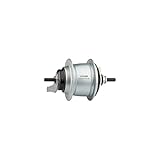
- 8-speed internal gear hub with 307% gear ratio
- Gear range:
- 1st gear = .527
- 2nd gear = .644
- 3rd gear = .748
- 4th gear = .851
- 5th gear = 1 (direct drive)
- 6th gear = 1.223
- 7th gear = 1.419
- 8th gear = 1.615
- 184mm axle length
- Single Cog Driver
- Coaster Brake
- With gear change support mechanism
- 36 Spokes
- Axle Type
- 2040 grams average weight
“Getting better with age.” This is a statement that best describes this best internal gear hub.
The Shimano Nexus is a heavy-duty gear hub that will serve you for more years than you can imagine.
With eight-speed gears, you can ride up and down hills with less effort. Riding on flats is smooth and enjoyable with its evenly spaced gears.
With a coaster brake, braking is quick and efficient. The absence of brake levers and cables makes the bike look neat and sleek.
More than anything, putting miles on this gear hub makes it smoother and quieter than when it was new.
Practical note: Current Shimano listings commonly show this family as SG-C6001-8C. Shimano lists the INTER-8 family at 307% range, notes the closer gear steps for more comfortable cadence, and lists 2040 g average weight for the coaster-brake version. That makes this a strong match for riders who value long-term city use more than low weight.
Buyer-focused advice: This kind of hub may work well if your rides are mostly pavement, bike paths, neighborhood roads, and moderate hills. It may be less ideal if you dislike coaster brakes or want finer brake feel at higher speed. Some riders love the clean setup. Others prefer a more familiar brake layout.
Why it stands out in this guide: the 8-speed range gives more room than a 7-speed commuter hub, but it still aims at practical, everyday riding rather than aggressive off-road use.
Best for Commuting: Shimano Nexus SG-C3000-7R Rear Hub

- 130mm over locknut dimension
- 182mm axle length
- Nexus 7-speed hub internal hub with total gear ratio of 244%
- Gear range:
- 1st gear = 0.632
- 2nd gear = 0.741
- 3rd gear = 0.843
- 4th gear = 0.989
- 5th gear = 1.145
- 6th gear = 1.335
- 7th gear = 1.545
- 36 Holes Spokes
- 182mm axle length
- Single Cog Driver
- the current Shimano SG-C3001-7R listing is the roller-brake version, so verify the exact suffix and brake version before ordering
- 1495 grams average weight
Are you new to gear hubs?
Are you looking for something you can use for your daily commute? Or are you perhaps into weekend adventures?
If your answer is “yes,” then you better check out this Shimano Nexus.
Having seven gears is more than sufficient for your daily rides to and from work. It is also suitable for long rides on predominantly flat terrain with mild inclines.
This hub, like any Shimano product, is sturdy. It can withstand a beating on rocky trails without requiring repairs. You can save a lot of time and money with how little maintenance it needs to keep working smoothly.
Practical note: Shimano describes the current SG-C3001-7R as a dependable 7-speed hub with smoother internal engagement. In plain terms, this is the type of hub that makes the most sense for flatter city routes, steady utility riding, and riders who want a simpler drivetrain without the extra weight of many 8-speed options.
Commuter angle: If your ride includes traffic lights, short climbs, wet roads, or carrying a bag to work, a 7-speed hub like this may feel easier to live with than a derailleur setup. But if your route is very hilly, the smaller overall range may feel limiting.
Best Internal Gear Hub for Leisure Rides: Sturmey-Archer S2C Kick-Shift Hub

- 2-Speed internal gear hub with direct drive (138% drive ratios)
- Kick shift between gears without shifters or cables
- Polished and anodized aluminum hub shell
- 3 Prong Cog Cassette Body Type
- Loose Ball Bearing Type
- Base gear and 38% overdrive
- Accepts standard 3sp/coaster style cogs
- Coaster Brake Compatible
- 1395 grams average weight
This gear hub exemplifies the saying “simple is best.”
With only two gears, one for direct drive and another for overdrive, it might seem unappealing to install this gear hub on your bike. However, if you love city riding and are not into adventurous terrain, then this Sturmey Archer hub is the best fit for you.
What’s most impressive about this gear hub is its kick-shift feature. Gear shifting is done by backpedaling. You also brake with the coaster brakes by backpedaling. This mechanism makes the bike free from cables and levers.
Also, since you can shift and brake hands-free, you can have better grip and control over the handles.
Maintenance is also simple. You just need to change the gear oil once in a while. No need for cable and lever replacements!
Saves a lot, doesn’t it?
Practical note: Sturmey-Archer’s current S2C page lists a 138% range, kick shifting without shifters or cables, and a weight range of about 1395 g to 1490 g. This is the simplest option in the guide, but also the easiest one to outgrow. It may suit riders who stay on flatter roads, ride for short leisure trips, or want a very clean city setup. It may not suit riders who face long climbs, carry heavy loads, or want a wider speed range.
Best way to think about it: this is not the “most capable” hub here. It is the “least complicated.” For the right rider, that could be the whole point.

What is an Internal Gear Hub
An internal gear hub refers to a bicycle gear system where all gears are contained and sealed inside the rear hub. The first internal gear hub (also called a gear hub) was issued in 1895. This gear system, which uses the same epicyclic principle as cars and motorcycles, has been in existence for a long time. The only reason it lost its popularity in bicycles is its limited gears. However, in the past decade, many bicycle parts manufacturers have developed an internal gear hub.
This system uses the principle of planetary or epicyclic gearing to change the bicycle’s gear ratios. Internally geared hub bikes do not require a derailleur. It usually has only a single cog sprocket.
Plain-language version: the gears stay hidden inside the rear hub instead of sitting outside the bike like a derailleur and cassette. That is why these systems often look cleaner and need less day-to-day tweaking.

How Does an Internal Gear Hub Work
The best internal gear hubs operate under the principle of planetary or epicyclic gearing.
This type of gear system has three main components to function. These are:
1) The sun gear/s;
2) The planetary gears; and
3) The ring gears.
The sun gear is fixed on the gear hub axle. The planetary gears revolve around the sun gear. The ring gear has inner teeth, and it surrounds the planetary gears.
Of the three parts, one acts as the input mechanism, another as the output mechanism, and the last one as the fixed or reactionary part.
Speed increases or decreases depending on which of the three components acts as the input and output mechanism.
The speed ratio is determined by the difference in the size of the sun gear/s in relation to the ring gear/s.
Gear hubs with more than three speeds have two or three planetary stages and two or more sun gears.
If that sounds technical, here is the short version: different parts inside the hub take turns doing the work, and that changes how hard or easy it feels to pedal. The rider gets multiple gears without an exposed derailleur.

Benefits of an Internal Gear Hub
Internal gear hubs carry a lot of features that make them more convenient to use over derailleurs. The most notable advantages they provide are:
Durability
In an internal gear hub, the majority of the gearing system is enclosed in a hub shell that bathes in oil. This prevents the gear parts from being exposed to mud, water, rocks, snow, and other external elements. As a result, a gear hub is less prone to natural wear and tear than the derailleur system is exposed.
With proper and regular lubrication, the best internal gear hub can last you a lifetime, and that is not an exaggeration.
Reliability
The best internal gear hub is also reliable that all its parts responsible for shifting are in a sealed, protected unit.
Inside the gear hub, there is no risk of bent, broken, or muddy gear that may interfere with changing gears.
This protection offered by the gear hub’s shell ensures smooth shifting at all times.
Requires less maintenance
The recommended maintenance for most internal gear hubs is to change the oil regularly. You can change the oil after six months from the first use and every one to two years thereafter.
Better Balance
Gear hubs are located at the lowest part of the frame. It is all in the centermost area of the bike. This places the center of gravity of the bike in the centerline.
Since the center of gravity is in the middle, bikes with internal gear hubs have better balance.
Shifting without pedaling
The best feature you will love about internal gear hubs is the ability to change gears while you are stationary.
With the best internal gear hub, you do not need to pedal to change your gears. You can do it even while you are not moving. This is awesome since you can immediately go to a higher gear from a stop position.
Reality check: Hub gears are not magic. You still need to care for the chain, watch for cable wear on some setups, and follow the service schedule for oil or grease. But compared with many derailleur setups, the day-to-day fuss is often lower.
IGH vs Derailleur: A Quick Decision Guide
Choose an internal gear hub if you want:
- less exposed drivetrain mess
- easy shifting at traffic lights
- fewer routine adjustments
- a bike for commuting, errands, and all-weather daily use
Choose a derailleur if you want:
- lower weight
- wider range for steep hills or sport riding
- easier part swaps at many bike shops
- a lower-cost entry point
That is the cleanest way to frame the choice. Hub gears are usually better protected, but they are often heavier and can cost more up front. Derailleurs are often lighter and can be more efficient when clean and well maintained.
Internal Gear Hub vs. Derailleur at a Glance
| Feature | Internal Gear Hub | Derailleur |
|---|---|---|
| Best for | Commuting, utility, bad weather, lower-fuss riding | Sport riding, steep hills, lighter builds |
| Shifting at a stop | Yes, on many models | No, usually must pedal |
| Exposure to dirt and impact | Lower | Higher |
| Weight | Usually heavier | Usually lighter |
| Range options | Often narrower at lower price points | Usually wider |
| Routine upkeep | Often lower | Often higher |
| Roadside simplicity | Less simple if internal issue happens | Usually easier to service or replace parts |
Commuter use case: If you ride to work, stop at lights, ride in the rain, or just want a bike that feels less fussy week to week, using the best internal gear hub makes a lot of sense. If your route is steep, sporty, or budget-sensitive, a derailleur may be the easier answer.

What to Look for When Buying for the Best Internal Gear Hub
Assembly
Internal gear hubs have all their gear parts already fixed inside the hub shell. Assembly would just include fitting the spokes on the hub and rim.
After that would be fixing the shifter cables depending on the shifter type that the gear hub comes with.
The next part of the assembly shall be putting brake cables and levers depending on whether the gear hub comes with a drum brake, coaster brake, or comes rim brake compatible.
The last part would be ensuring that the gear hub is properly oiled and the chains adequately lubed.
Ease of assembly is not really one of the things you should focus on when choosing for the best internal gear hub. After all, the gear hub comes assembled, and only the external shifting and braking mechanisms need to be attached. But, if you prefer something simple, you can go with single to three-speed internal gear hubs with: (1) coaster brake; and (2) kick shift mechanism. This saves you from the hassle of placing shifter and brake cables and levers.
Buyer note: A better question than “Is this easy to assemble?” is “Will this fit my bike?” Check rear spacing, brake type, spoke-hole count, axle style, and whether your frame can keep proper chain tension. Compatibility problems are one of the fastest ways to turn a good-looking hub into a bad purchase.
Selecting sprockets and chain wheels
Choosing the right size of the sprocket and the chain wheel can raise or lower the overall gear range of the internal gear hub.
It is essential to choose a sprocket that is compatible with the best internal gear hub. You must also note the gear ratios you need for the type of terrain you want to ride.
Lubrication
Oil or grease may be used to lubricate the internal hub gear depending on the model of the gear hub.
Manufacturers typically indicate the recommended oil for lubrication. The period or regularity of changing oil is also indicated in most manuals.
Make sure to always check the manufacturer’s user guide in order to ensure that you are using the proper lubricant.
Gear Ratio
The overall gear ratio is the most important thing to check when buying for the best internal gear hub.
Overall gear ratio refers to the difference between the lowest and the highest gear. This is in relation to the distance covered by the wheel for every pedal you make under such gear.
It is essential to know the gear ratio because this will tell you if you are buying the right gear hub. If you love climbing hills but buy a gear hub with a limited gear ratio, you run the risk of walking with your bike instead of riding it.
Why?
When climbing up a hill, you will have to shift to a lower gear in order to make pedaling easier. With a lower gear, you are able to increase your cadence in order to cover as much distance as you can with a higher gear.
If you cannot downshift to a lower gear, pedaling becomes difficult, and your cadence will drop. This will make the distance you can cover drop as well. In this instance, walking your bike becomes way easier than riding it.
That is why it is crucial to think about where you like to bike before changing to an internal gear hub. Your choice of terrain will dictate the gear ratio of the gear hub you will need to buy. Always keep this in mind.
Maintenance
The best internal gear hubs may be oil-based or grease-based. The majority of internal gear hubs with three (3) to eight (8) gears are grease-based. Those that have more than eight gears are predominantly oil-based.
Most grease-based hubs need to be cleaned and regreased at least every one to two years. The regularity of cleaning and regreasing depends on the frequency of use. If you take your mountain bike daily for long rides, cleaning and regreasing is advisable annually.
Oil-based internal gear hubs need regular oil changes. Draining the old oil and changing it with new oil has to be made annually in order to maintain the gear hub’s optimum performance.
The seals also need to be changed and replaced every once in a while. It is essential to do this in order to prevent the oil from leaking. Once in a while, depending on the seal’s condition, may range from a year to more.
Overall, the maintenance of a hub gear is simple, whether it be oil-based or grease-based. What is important is to know the right lubricant for your gear hub. Also, if you have never done an oil change before, it is best to go to a bike shop and have it done there the first time.
Maintenance Tips
- Oil-based hubs: Change oil once a year to maintain peak performance.
- Grease-based hubs: Clean and re-grease every 1–2 years, depending on how often you ride.
- Seal checks: Inspect seals annually and replace if you notice any leakage.
Tradeoff note: Lower maintenance does not mean zero maintenance. But for riders who dislike frequent derailleur tuning, the slower service cycle is often a major selling point.

Internal gear hub vs. derailleurs
Both an internal gear hub and a derailleur are good gearing systems.
The main points of difference between the two are:
Parts longevity
The parts of an internal gear hub are protected inside a sealed unit. This protects it from the normal wear and tear of external forces. As a result, internal gear hubs can last for years without replacements as opposed to derailleur gears.
On the contrary, all parts of a derailleur system are exposed to extrinsic factors. This makes it prone to damage. The derailleur, chain, and cassette sprocket often get broken. As a consequence, these parts need to be replaced and repaired frequently.
Maintenance
All parts of a gear hub are contained inside the gearbox. These parts are all soaked in oil. Maintenance of the hub requires changing the oil every one to two years.
There is no need to change or repair parts as often as you do with the derailleur system. This makes internal gear hubs cheaper and less taxing to maintain.
Weight
Internal gear hubs tend to be heavier than the standard hub because of all the gears contained inside. Internal gear hubs will weigh around 1500 to 2500 grams on average. This is far heavier than the weight of a standard rear hub, cassette sprocket, and rear derailleur.
Shifting
One of the best things about internal gear hubs is that it allows shifting while stationary unlike in a derailleur system where you need to be pedaling before you can change gears.
Brake compatibility
Internal hub gear can come with drum or coaster brakes; some are rim brake compatible. On the other hand, derailleur bikes usually go with either rim or disc brakes.
Gear Ratios
Gear hubs have a lesser overall gear ratio than bikes with a derailleur drivetrain. Modern-day wide gear range can be single speed up to fourteen (14) speeds. This is actually a lot to get you to places but still less than the twenty-seven (27) or more speeds of a derailleur drivetrain.
Summary: Internal Gear Hub vs. Derailleurs
| Feature | Gear Hub | Derailleur System |
|---|---|---|
| Protection | Sealed in oil; resists mud and water | Exposed to elements; more frequent repairs |
| Maintenance | Oil change or greasing annually | Cable adjustments; more part replacements |
| Shifting | Shift while stationary if you prefer | Must pedal to shift |
| Weight | Usually heavier | Usually lighter |
| Best use case | Commuting, utility, all-weather riding | Sport, performance, wide-range riding |
| Repair style | Often low-fuss day to day, but less simple if internals fail | More exposed, but usually easier to service part by part |

Most Commonly Asked Questions
Conclusion on the Best Internal Gear Hub
Biking is fun. But the costs of maintaining it can be discouraging.
That is why internal gear hubs are worth a try.
When comparing the price of the best internal gear hub with standard hubs, it might seem quite expensive. But then, when you make the comparison, you have to add the following to the standard hub price;
1) The cassette sprocket;
2) The derailleur;
3) The brake set.
After doing this, you will actually see that there is not much difference between the two. In fact, some hub gears may be cheaper.
In addition to the purchase price, you also have to add maintenance costs.
This is where the best internal gear hub will greatly outperform the derailleur system.
Internal gear hubs are low maintenance and extremely durable.
An internal gear hub could be a smart long-term fit if you value simplicity, cleaner looks, stop-and-go convenience, and lower day-to-day fuss. It is not the right choice for every rider. But for commuters, utility riders, and many everyday cyclists, it solves real problems that a derailleur setup does not always solve as neatly.
So if you are choosing between “lighter and sportier” versus “cleaner and easier to live with,” that question may guide you better than any hype ever will.
In this guide, the Sturmey Archer S80 / X-RD8 remains the best internal gear hub since it’s the most flexible pick because its 325% range gives it more room than the others here. But that does not make it the best choice for every rider. If you want a smoother city setup and do not mind the brake format, a Shimano Nexus SG-C6000-8C family hub may fit better. If you want the simplest setup of all for easy leisure riding, the S2C still earns a place.
Have a fun ride!