Best Mountain Bike Trainers
- Best Overall: Sportneer Bike Trainer Stand
- Best Alternative: Alpcour Bike Trainer Stand
- Best Value for Money: Sportneer Fluid Bike Trainer Stand
- Best Entry Level: Conquer Indoor Bike Trainer
- Best Design: Garmin Tacx Neo 2T Smart Trainer
- Best in Versatility: Saris M2 Electromagnetic Resistance Bike Trainer
- Best Lightweight: RAD Cycle Products Max Racer
- Best Performance: Tacx Flux 2 Smart Trainer
If you’re serious about training for a mountain bike race, you need to get yourself a professional-grade trainer.
The problem is that there are so many options on the market, and it’s hard to know what one is best.
We’ve done all of the research for you, and we can help you find the best mountain bike trainer in your price range! Here’s our list of top 8 picks (in no particular order).
Different Trainer Types
- Wind trainers blow air with a fan into a stationary tube. It’s within the mountain biker’s best interest to find one that won’t disturb their roommates or neighbors at night with loud noises from the fan.
- Fluid trainers use a rotating impeller which powers an impeller shaft and an impeller wheel. The mountain biker is required to set the rear wheel on the bike trainer for it to spin, with fluid bike trainers being less expensive trainers than magnetic ones. They use fluid for resistance, which increases as the rider pedals faster. They are quieter and more precise than wheel-on trainers, but can be pricier.
- Magnetic trainers use a flywheel and brake pad which create resistance when they meet each other. As mountain bikers pedal, the speed of the flywheel varies to adjust resistance. Besides mtb trainers, there are also stationary exercise bikes for mountain bikers to use when they can’t make it out to their ride locations because of bad weather or darkness.
- Wheel-on trainers: These trainers use a roller against the bike’s rear tire. They are cheaper but can be noisier and less precise.
- Direct drive model trainers: The bike is fixed onto the direct drive trainer’s flywheel, offering a more accurate and realistic ride feel. They cost more but are considered better quality.
- Smart trainers connect to training apps, offering a virtual riding experience and progress tracking. They can be wheel-on smart trainers or direct drive smart trainers, and use fluid or magnetic resistance. They are more expensive but provide a more interactive training experience.

19,446
Need a Few Practical Extras for Your Next Ride?
Browse cycling-related clothing and simple bike accessories that may help with comfort, visibility, storage, or everyday riding.
Paid links. As an Amazon Associate we earn from qualifying purchases.
Customer Reviews

14
Testing Hours

8
Tested Products

11
Sources Researched
8 of the Best MTB Trainers
Sportneer Bike Trainer Stand
Best Overall: Designed for an ultimate training experience

- Alloy steel frame material
- 300 lbs load capacity
- Six magnetic resistance settings
- For 26 – 28 inches or 700c wheels
- With adjustable anti-slip rubber foot pads
- Weighs only 8 kg
Sportneer bike trainer stand, one of the best bike trainer, is designed with a broad base plus low stance to give you a strong balance while intensively training. Uneven flooring is not a problem with its adjustable anti-skid rubber.
Sportneer’s seamless design with a noise reduction wheel makes your workout as quiet as can be. Not only that, but the lessened friction also prolongs your bike tire’s life. The 6-resistance settings support wide-range cycling conditions so you can confidently train to your standards.
Disassembling the trainer is also accessible so that you can set it up anywhere in just a few minutes.
Alpcour Bike Trainer Stand
Best Alternative: A quiet and shake-free magnetic mechanism
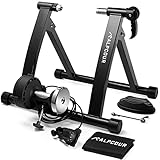
- Stainless steel frame material
- Six magnetic resistance settings
- For 26 – 28 inches or 700c wheels
- With anti-slip rubber pads
- Weighs 11 kg
If you plan to train using road and mountain bikes, the Alpcour bike trainer stand is a great choice. Thanks to its quiet magnetic technology, which eliminates whirring and humming.
Its high-quality flywheel mechanism generates a grind against the tire for an ultimate cycling experience, yet you and your neighbor will not be bothered by extreme noise.
The heavy-duty stainless steel plus anti-slip rubber pads provide a stable and shake-free riding experience. You can also access the six resistance settings without difficulty with the remote attached to the handlebar.
The package also includes a sturdy bag for storage and easy carrying. So you can easily bring your home trainer to the best cycling courses.
Sportneer Fluid Bike Trainer Stand
Best Value for Money: Stable plus noiseless training

- Alloy steel frame material
- Fluid resistance mechanism
- 300 pounds load capacity
- For 26 – 29 inches or 700c wheels
- With anti-slip rubber pads
- Weighs 11 kg
Sportneer fluid offers imaginably stable and durable trainers in the market. Thanks to its heavy-duty alloy steel body, this boosts its stability so you can enjoy it for more years. It also features a specialized wheel with noise-reduction to help keep a quiet and solid workout.
With a fluid resistance mechanism, you’ll experience minimal whirring and jarring. Setting up this stand is also a piece of cake with additional features like a quick-release skewer and front-wheel riser.
With the features of Sportneer Fluid Bike Trainer Stand, you get the best value-for-money trainer stand for road and mountain bikes.
Conquer Indoor Bike Trainer
Best Entry-Level: The basics for your initial training
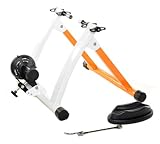
- Extra-wide alloy steel frame material
- Single adjustment
- Progressive magnetic resistance
- For 26 – 28 inches or 700c wheels
- With front-wheel riser
- Tool-free assembling
If you’ve never used a trainer stand before, Conquer bike trainer will quickly get you up and running. Its extra-wide alloy steel frame is a great weight and balance support. The magnetic resistance also assures smooth and efficient pedaling, so you enjoy more while training.
Another feature of Conquer is its front wheel riser block, an added stable. Exclusively designed for indoor cycling, you don’t need any tools in assembling and dismantling this trainer stand.
Plus, Conquer’s price is budget-friendly, so you don’t need to empty your pocket to start training.
Garmin Tacx Neo 2T Smart Trainer
Best Design: For a more realistic road feel

- Neodymium frame material
- 32 neodymium magnets
- Max wattage: 2200w
- Improved pedal stroke analysis cordless

If you’re searching for a techier trainer, Tacx Neo 2T smart trainer offers technology infusion. The Edge 1000 GPS-Enabled Cycling Computer is designed to help you improve your cycling performance. It studies your stroke using Edge bike computers to improve bicycle dynamics.
The integrated 32 neodymium magnets permit high brake force and power output levels. So it can effortlessly keep up with your intense indoor training setup without compromising balance and stability.
You will also experience a more realistic road feel with Tacx software and the Zwift training app. In addition to this, Dynamic inertia compensates for weight, angle of inclination, and speed for an ultimate road feel. The new motor design also allows greater power accuracy at low speeds for a better simulation during a climb up to 25% gradient.
Of course, comfort is also a priority with the redesigned magnets for reduced vibrations so less noise and whirring. Plus, Tacx Neo 2T smart trainer responds immediately to incline changes and follows your body’s natural movement.
Saris M2 Electromagnetic Resistance Bike Trainer
Best in Versatility: A “do-it-all” trainer to maximize your training experience

- Aluminum frame material
- Electromagnetic resistance mechanism
- Compatible with Zwift, Rouvy, and TrainerRoad apps
- 300 pounds load capacity
- No external sensors required
- Weighs 10.5 kg
A “do-it-all” trainer is what you get with Saris M2. It connects to training apps like Rouvy, Zwift, and Trainer road apps for a customized avatar and group ride training. It’s a match for all activity and other riding purposes, so you can indeed maximize your training experience.
With its integrated power measurement, integrated speed and cadence sensor, external sensors are not needed to track and record performance data. The power tap technology gives -/+ 5% accuracy power reading. You can go up to 1.500 watts at 20 mph and 15% climbing grade. And since it only weighs 10.5 kg, you can easily fold and assemble it anytime.
RAD Cycle Products Max Racer
Best Lightweight: Wide-range magnetic resistance ad feathery feel
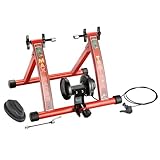
- Metallic fiber frame material
- 7-level magnetic resistance mechanism
- No-slip floor grip stabilizes the front wheel
- For 26 – 28 inches or 700c wheels
- Weighs 18 lbs
Rad Cycle Max Pro features super lightweight and extra-wide legs yet sturdy frames. The no-slip floor grip also adds stability to the front wheels. Besides, you can easily fold for minimal storage and traveling.
This trainer is also well known for its powerful 7-level magnetic resistance, which you can adjust for wide-range road conditions. At the same time, you’ll get more extensive training and exercise without having to worry about the noise since MAX Pro is one of the quietest.
Both newbies and seasoned riders can use this trainer for a road-like feel in the comfort of their homes. It’s best for serious cyclists who want to take cycling training a notch higher.
Tacx Flux 2 Smart Trainer
Best Performance: High-quality features within your budget limit

- Magnetic resistance mechanism
- 2,000 W max wattage
- Axle compatibility
- 2.5% accuracy
- 7kg flywheel weight
If you are in the marketplace for a bike trainer with a tight budget, Flux 2 smart trainer is a perfect one. This trainer comes with a wide range of benefits, but you don’t have to empty your wallet to use it. Flux 2 smart trainer comes with reliable measurements with 2.5% accuracy.
The large footing ensures superb stability even on fast bursts. On the other hand, vibration is minimal, so you enjoy noise-free training.
Flux 2 smart trainer also comes with axle adapters so that fitting won’t be a problem. Though not foldable, it won’t occupy much space as it is designed with a smaller base footprint but is still robust.

What to Look for When Buying a Mountain Bike Trainer
Portability
Portability is an important consideration. You’d want one that’s easy to dismantle and can be packed away in a corner when not in use. Easy to transport for road trips or even between multiple homes is an excellent option.
Resistance level
This depends on your preferences. Choose a trainer with resistance bands or adjustable magnets to adjust the mtb trainer’s resistance level.
Wind bike trainers have a fixed resistance level, meaning mountain bikers have to choose their gear properly for them to be able to pedal against the wind.
Magnetic trainers have a more fluid resistance level. Rather than mountain bikers selecting their gears, bike trainers adjust the trainer’s resistance level as mountain bikers ride on them.
Fluid trainers have a fluid resistance level, though mountain bikers may change the bike trainer’s setting from high to low gears to alter the bike trainer’s fluidity. They allow for a more authentic riding experience with little to no jarring stops when coasting.
Noise Level
Another thing to consider is the noise level of the trainer. Some trainers can be real loud and that’s a drag if you’re using it in a shared space or if you don’t wanna tick off your neighbors. Look for trainers that are designed to be quiet or have noise-cancelling features.
Bike Compatibility
You also need to make sure that the trainer you pick is compatible with your mountain bike. Different trainers are made to work with different types of bikes, so make sure you check the specs before you pull the trigger. And don’t forget to see if you need any extra adapters or accessories to get it to work with your bike.
Cost
Bike trainers are pricey compared to regular stationary exercise bikes, so mountain bikers must set a budget before purchasing a bike trainer.
Like any mountain biking gear, mountain bikers should look for mtb trainers that fit their budgets while still meeting their training needs. There are trainers under $100 and smart trainers over $1000, so one’s got to be within mountain bikers’ price ranges.
For light use, get a bike trainer for under $100. However, mountain bikers who will be using the bike trainer daily should go for the best smart trainers for over $300 with accessories like quick-release skewers and riser blocks which mountain bikers can also choose to buy separately.
The Firmness of the Frame
Another thing to consider is to look for bike trainers with a strong and stable frame. Mtb trainers have higher weight capacities due to mountain bikes’ added weight than road bikes. The frame should be able to withstand usage. Usually, trainers come with a warranty for their frames.
Extra Features
Last but not least, think about any extra features that you might want in a smart trainer. Some come with a power meter to help you track your performance, while others can connect to apps and training programs. Decide what features matter most to you and choose a trainer that’s got what you need.

Frequently Asked Questions
Why should you train indoors?
Riding on bike trails is enjoyable. However, mountain biking trails are often muddy and dirty; they can also be very dangerous, especially riding downhill. When it’s raining outside, mountain biking becomes nearly impossible due to the risk of slipping on wet ground. Indoor cycling lets you ride all year long without worrying about any of these factors.
Can you put a mountain bike on a trainer?
Yes, mountain bikes are not too different from regular bicycles in that you can place mountain bikes on trainers. However, it is important to check if bike trainers have tire blocks that hold the tires at the bottom of the trainer.
Which type of bike trainer is best?
Stationary trainers provide ample features and come at an affordable price. They are easy to store, have more features than most roller trainers, come at different prices, so no one will be uncomfortable in the price range – even if you’re on an expensive hobby!
How can I use my mountain bike as stationary?
Wheel strain and sweat corrosion are two potential issues that may arise when riding indoors.
Wheel strain is a simple physics problem. The maximum stress on your rear wheel occurs when the axle meets the dropouts. This point can be shifted slightly by changing which side of the wheel flanges up against the cassette and chainrings. Bike trainers typically allow you to choose between aligning with either flange (thus putting extra stress on the opposite flange).
The sweat corrosion issue is specific to mountain bikes that use aluminum frames; to deal with all the dirt encountered by mountain bikers, mtb components are generally made of anodized aluminum. Anodization involves painting the surface of the metal to seal it off from further corrosion. But sweat contains lots of salt, which can corrode exposed aluminum parts. To combat this problem, bike components are often made with an internal cavity that allows the salty sweat to drain out the bottom. However, these chambers tend to trap water inside, which can then cause corrosion on any aluminum surfaces on the component exposed on the top side.
In short, mountain bikes are far more susceptible to trainer damage than road bikes because bike components tend to be less sturdy, and mountain bikers sweat a lot. You need to be more careful about trainer setup if you own a mountain bike.
What cassette do I need?
You’ll, of course, need a mtb cassette. But more specifically, you’ll want a bike cassette with the same number of cogs as your rear derailleur has available to it. You can check this by seeing how many cogs are included in the range of movement from your lowest gear to highest gear (e.g., there should be nine for a 9-speed mountain bike).
What is Virtual Power?
Virtual Power (or Trainerspeak for “Trainer Resistance”) is a feature in some cycling computer head units. It allows you to estimate how much resistance the trainer applies based on the speed of your wheel and the gearing ratio, which can be measured by your hub or pedal sensor. If you’re riding in a virtual mountain environment and need to maintain a specific speed to clear an obstacle, this can be helpful. But in general, it’s just a feature for bragging rights.
Should you lock out your suspension?
Yes. If your mtb has a suspension fork, lock it out before getting on the trainer. The air pressure inside the forks is much higher than outside air pressure. When you stand up and put weight on your mountain bike’s front end while riding indoor trainers, the increased air pressure from this added weight can be enough to compress the spring inside the forks.
You can usually unlock the fork afterward, but riding with an unlocked suspension fork indoors is extremely dangerous because it could collapse at any time, sending you flying over the handlebars.
Conclusion on the Best Mountain Bike Trainer
If you’re having difficulty picking your bike trainer, we highly recommend Sportneer Bike Trainer Stand as the best bike trainer. Even with extreme workouts and training, you can always depend on its alloy steel frame for a strong balance and support.
You can also adjust the 6-resistance setting to experience wide-range cycling conditions. Plus, packing and storing this trainer is easy and would not take much of your space.
Have a fun ride!
References
- Snyder, B. J., & Fry, A. C. (2017). Rollers versus trainers: 10–km time trial. Journal of Exercise Physiology Online, 20(4), 1–12. https://pmc.ncbi.nlm.nih.gov/articles/PMC5466401/2
- Sperlich, B., Zinner, C., & Holmberg, H. C. (2018). Resistance training among competitive mountain bikers and adherence to recommended training guidelines. The Sport Journal. https://thesportjournal.org/article/resistance-training-among-competitive-mountain-bikers-and-adherence-to-recommended-training-guidelines/