Key Takeaway:
- BMX stands for “Bicycle Motocross.”
- It began in the 1960s when kids imitated motocross racing on bicycles.
- Two main disciplines developed: Racing and Freestyle.
- BMX gained international recognition by the UCI in 1983 and became an Olympic sport in 2008 (Beijing Games).
- BMX bikes are designed for strength, agility, and stunts across different riding styles: street, park, dirt, and flatland.
If you’ve ever wondered “what BMX stand for,” the answer is Bicycle Motocross — a cycling sport that began in the 1960s and grew into one of the most popular biking subcultures worldwide.
Originating when young riders in California mimicked motocross racing on dirt tracks, BMX combines the excitement of racing, tricks, and freestyle riding in one versatile sport. Today, it spans everything from Olympic racing to urban street tricks.

What Does BMX Stand For? A Quick Definition
BMX stands for “Bicycle Motocross.” It is a cycling discipline inspired by motocross racing, involving either dirt-track racing or freestyle tricks. The crossover aspect of bicycles with motocross-style racing is what gave the sport its name.
Need a Few Practical Extras for Your Next Ride?
Browse cycling-related clothing and simple bike accessories that may help with comfort, visibility, storage, or everyday riding.
Paid links. As an Amazon Associate we earn from qualifying purchases.
Historical Note: BMX was officially acknowledged by the Union Cycliste Internationale (UCI) in 1983 and gained Olympic recognition when it debuted in the 2008 Beijing Games.
👉 Related: How much do BMX bikes cost
Freestyle and Racing BMX
When BMX first began, the focus was mainly on racing—speed, jumps, and style. Over time, riders added tricks, which gave rise to two distinct branches:
- Freestyle BMX – Stunt riding with tricks like spins, grinds, tailwhips, and wheelies.
- Racing BMX – Competitive dirt-track racing with berms, jumps, and obstacles.
Expert Insight: Research highlights that BMX racing typically covers 300–400 meters, and performance depends heavily on efficient gate starts, sprinting ability, and rider position in the opening seconds of a race (Bertucci et al., 2007).
Breaking Down BMX Types
Beyond racing and freestyle, BMX culture has evolved into four core sub-disciplines:
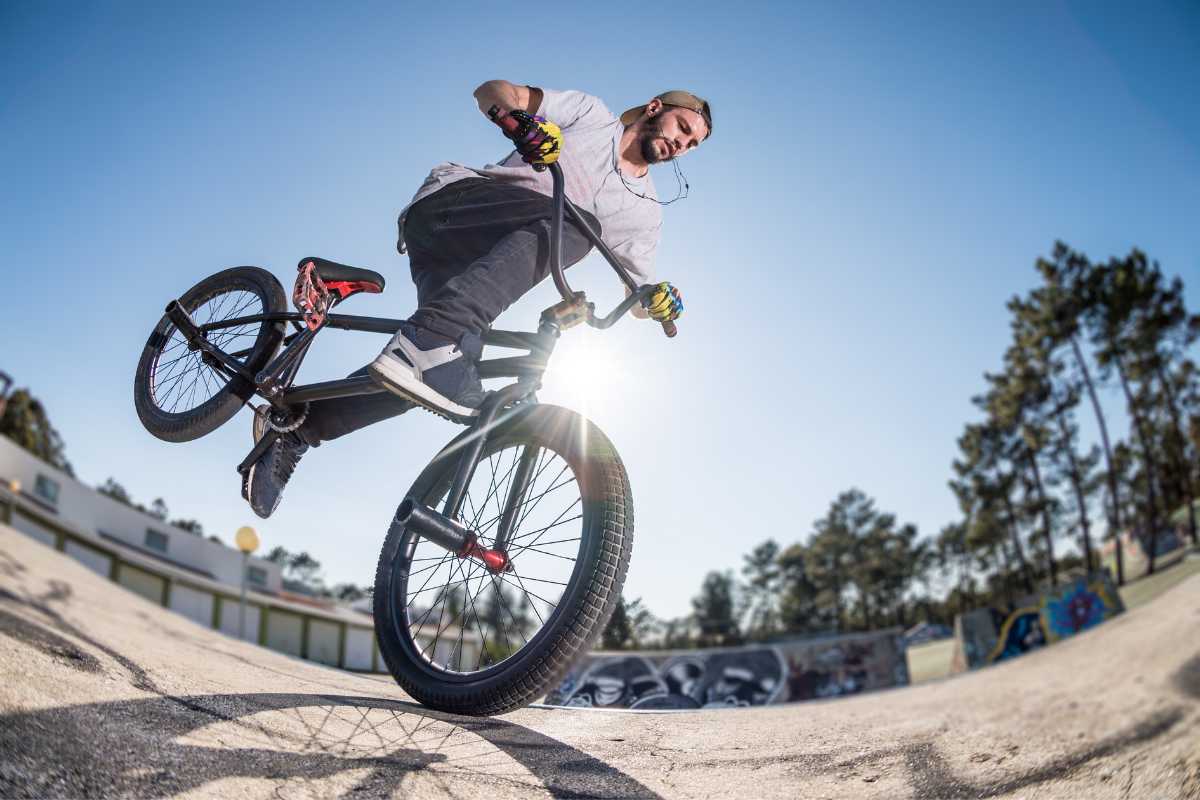
- Street Riding – Urban setups with ledges, rails, and stairs. Popular tricks: manuals, barspins, grinds.
- Park Riding – Performed in skateparks with quarter pipes, spines, and box jumps. Popular tricks: flips, 540s, backflips.
- Dirt Riding – Big jumps, berms, and tabletops. High-risk, high-reward style.
- Flatland – Balance-driven tricks on flat ground; requires precision and control.
Fun Fact: These disciplines now have formalized competitive events and frameworks, showing BMX’s growth into a mainstream global sport (Camilleri et al., 2025).
Street Riding

Ever seen BMX riders setting up and riding unique setups in the streets? This is street riding. Street riders look for any urban setup with ledges, rails, and stairs to perform tricks.
Unleash your creativity and ride any terrain to nail those tricks. Whether you want to do grinds, manuals, nose manuals, barspins, tailwhips, or spins—the possibilities are endless for having fun on the spot!
Park Riding
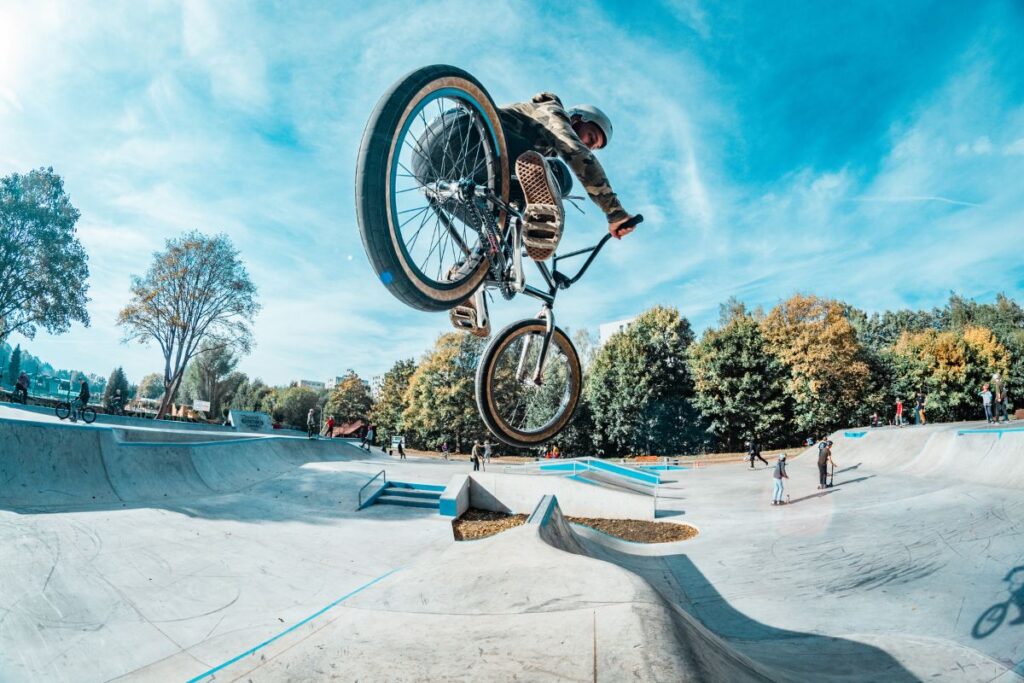
This type of BMX riding involves riding on transitions such as spines, box jumps, and quarterpipes. This is what you can usually find in skateparks and BMX parks. Park riders are often seen performing tricks like flips, 540’s, and backflips.
Dirt Riding

As the name suggests, this style of BMX riding involves riders taking on jumps, big berms, and tabletops. A biker’s imagination is their only limit when performing dirt riding tricks. This is one reason why type of riding is not for the faint-hearted. Park riding requires a lot of skill, courage, and determination.
Flatland

Early ramp riding and riders used to have limited space to express their creativity. As technology progressed, flatland riding emerged. This type of BMX riding involves a lot of balance and footwork as riders perform their tricks on a flat surface.

BMX and Regular Bike: What’s the Difference?
BMX bikes are built for strength and agility to handle the punishment of off-road riding. The frame is thicker than regular bicycles and made of tougher materials like chrome-moly or aluminum. The wheels are also much harder, and the tires have more grip.
A BMX bike’s smaller size makes it easier to maneuver. The geometry makes the bike more responsive and agile on the track or in the street. BMX riders have more control over the bike when performing tricks and sometimes even ride without brakes.
Makes of regular bicycles, on the other hand, design their bikes for comfort. The wheels are softer, and the tires have less grip, making them more comfortable to ride on roads or pathways. The frame is usually thinner than a BMX bike and made of lighter materials like steel or titanium.
It’s quite easy to distinguish a BMX from a regular bike. These basic bikes have simple parts that are easy to build, service, and repair. They have a smaller frame and wheels and distinct u-shaped handlebars.
Related article: BMX vs mountain bike
BMX Bikes: What Are They Good For?
BMX bikes are great for everyday riding, commuting, and even racing. Freestyling BMX riders love to ride them to perform various tricks since their smaller size gives them more control.
On the other hand, racing BMX bikes are for competing on the track. They are incredibly lightweight and agile, with a low center of gravity that makes them ideal for tackling tight corners and jumps.
BMX Bikes are about pushing your strength and balance capabilities to the limit and exploring other mental challenges. BMX is a serious workout for both body and mind; it tests one’s tolerance for pain, ability to assess risks, and knowledge of geometry and physics – all crucial components that carry well beyond pedaling on a bicycle.
👉 New riders: Best beginner BMX bike
Choosing A BMX Bike
Think about what terrain you’ll be riding on and what kinds of tricks you want to perform. If you’re into flatland, a regular BMX bike will work fine, but if you’re into dirt riding, you may want a full-suspension bike.
When choosing a BMX brand, consider the bike frame, wheels, and tires. A good frame should be strong enough to handle the stresses of off-road riding, while the wheels and tires should be able to grip the terrain.
Ultimately, the bike you choose should depend on your budget and experience. There are numerous bikes available to fit any requirement. For example, novices would benefit from a beginner-level BMX with race-style frame, while professional athletes may opt for a jumpstyle frame with more features.
👉 Related: Best BMX freestyle bikes, Best BMX bikes for kids


Learning BMX Tricks
Want to get started on your BMX journey? Here are tips to help you start your adventure.
- Start small and work your way up. Start with simple tricks like bunny hops and wheelies. This will help you get more comfortable with the bike.
- Practice in a safe environment. Always use proper safety gear such as helmets and knee and elbow pads. Gloves are also a great investment, as they will help you better grip the handlebars.
- Watch tutorials. Watching professional riders perform tricks can be very helpful in learning new stunts.
- Take your time. Don’t rush it, or you may injure yourself. Take your time to understand the mechanics of each trick and practice carefully.
- Don’t be afraid to make mistakes. You’ll only learn by trial and error, so don’t be afraid to make mistakes.
- Find BMX riders who are more experienced than you and watch them perform their tricks. This will help you get an idea of what is possible and inspire you.
- Practice, practice, practice! This is the only way to get better. Try to practice every day, even if only for a few minutes.
- Be patient, and don’t get discouraged. It takes time to learn new tricks, but with dedication and practice, you will get there!
- Have fun, and stay safe! BMX riding is meant to be a fun experience, and it’s important to stay safe. Wear the proper safety gear, use common sense, and always be aware of your surroundings.

BMX in Sports Science and Research
Studies on BMX racing emphasize biomechanics and physiology. Researchers found that the starting phase is critical to success, since early acceleration sets the tone for the rest of the race (Bertucci et al., 2007).
Other insights include:
- Sprinting power and body position influence lap times.
- Feedback and coaching improve rider efficiency
- BMX biomechanics continue to be analyzed across performance, health, and even injury prevention (Camilleri et al., 2025).
This highlights that BMX isn’t just a recreational sport — it’s studied academically as a discipline combining strength, speed, and technical skill.
Conclusion on What BMX Stand For
So, what does BMX stand for? It stands for Bicycle Motocross, a sport that grew from 1960s dirt tracks into a global phenomenon with freestyle, racing, and Olympic recognition. BMX bikes are built for agility, tricks, and performance, making them perfect for riders who want both adventure and athletic challenge.
Whether you’re new to BMX or looking to refine your riding, this sport offers a unique blend of culture, competition, and creativity.
References
- Bertucci, W., Hourde, C., Manolova, A., & Vettoretti, F. (2007). Biomechanical and physiological aspects of BMX performance. Journal of Sports Science & Medicine, 6(4), 1-10. https://www.researchgate.net/publication/236660801_Determining_factors_of_the_sprint_performance_in_high-level_BMX_riders
- Camilleri, D., et al. (2025). Scoping review of BMX literature. Journal of Human Sport and Exercise. https://www.jhse.es/index.php/jhse/article/view/bmx-scoping-review-literature