Key Takeaway: Mountain bikes can handle roads comfortably and offer stability on mixed surfaces, but they are less efficient and slower than road bikes, requiring more energy due to their wider tires, suspension, and upright riding position.


Are mountain bikes good for the road?
Yes, they can be very good for the road if your rides include rough pavement, potholes, curb hops, mixed surfaces, or short city commutes. But if most of your route is smooth pavement and you care about speed, a mountain bike will usually feel slower and require more effort than a road bike.
Mountain biking and road biking are two different sports with a lot of common ground and some key differences. Mountain bikers often debate whether mountain bikes are suitable for the road and vice versa.
Need a Few Practical Extras for Your Next Ride?
Browse cycling-related clothing and simple bike accessories that may help with comfort, visibility, storage, or everyday riding.
Paid links. As an Amazon Associate we earn from qualifying purchases.
For everyday riders, the real question is not just “Can you ride a mountain bike on the road?” It is “Will it feel efficient enough for the kind of road riding you actually do?”
If your roads are cracked, uneven, or mixed with light gravel, an MTB can feel stable and confidence-inspiring. If your goal is covering miles fast on clean pavement, it is not the most efficient tool.
For someone who juggles city commutes and weekend gravel runs—a well-tuned MTB can surprise you with its ride-smooth comfort on pavement, even if it’s not built for speed.
This blog post will explore the pros and cons of each type of biking to help you decide which is right for you.
Why Use a Mountain Bike on the Road?
Mountain bikes are designed for off-road riding, and they are great for tackling rough terrain. They are also very versatile bikes that can be used for various activities.
Mountain bikes are usually heavier than road bikes, making them slower on the road. However, they are more durable and can handle more abuse, making them a good choice for bikepacking or touring.
Mountain bikes also have wider tires than road bikes, making them more comfortable to ride on rough roads. And, if you are looking to do some light off-roading, a mountain bike can handle that as well.
So, if you are looking for a bike that can do it all, a mountain bike is a good option.
That versatility is the main reason many riders keep using an MTB on pavement. You can commute during the week, roll over rough shoulders and broken asphalt, and still head onto trails or gravel on the weekend without changing bikes.
When a Mountain Bike Makes Sense on Pavement
A mountain bike is often a smart choice for road riding if:
- your city streets are rough or full of potholes
- you ride a mix of pavement, gravel, and dirt
- you value comfort more than top speed
- you are new to cycling and want a stable, confidence-building bike
- you use one bike for commuting, errands, and recreation

The Cons of Riding a Mountain Bike on the Road
Mountain bikes are not as fast as road bikes, and they are not designed for speed. The wider tires can also make it more difficult to pedal, and the heavier frame can make it harder to keep up with traffic. This is because the wider tires have greater rolling resistance.
Mountain bikes can also be more difficult to maneuver in tight spaces, and they are not as easy to store or transport.
Not to mention saddle pain. Road bikes have narrower seats designed for long-distance riding, whereas mountain bike saddles can be wider and more padded for comfort. However, this can also make them less comfortable for extended periods.
Mountain bikes with suspensions also have a drawback on the road. The suspension adds weight and can make pedaling more difficult. It can also make the bike less stable on the road, which is not ideal for riding in traffic.
Still, there are easy solutions to some of these problems. So keep reading.
Research supports the idea that tire choice and riding position matter a lot. Studies on cycling performance show that rolling resistance changes with tire type, surface, and inflation pressure, while more aerodynamic positions help reduce drag at speed. That helps explain why many MTBs feel slower on paved roads than road bikes, especially on longer rides or faster commutes (Bertucci et al., 2013; Faulkner et al., 2021).

How is an MTB different than a road bike?
The main difference between mountain bikes and road bikes is the tires. Mountain bike tires are wider with more tread, designed for off-road riding. Road bike tires are thinner with less tread, designed for speed and efficiency on paved surfaces.
Mountain bikes also have suspensions to absorb shocks from rough terrain, whereas road bikes do not.
Another difference is the gear ratio. Mountain bikes have lower gear ratios for climbing steep hills, and road bikes have higher gear ratios for going fast on flat surfaces.
Finally, mountain bikes are usually heavier than road bikes because they are more durable.
The riding position also matters. Most mountain bikes put you in a more upright posture. That often feels better for visibility and comfort, but it is usually less aerodynamic than the lower, more stretched-out position on a road bike (Faulkner et al., 2021).

Mountain Bikes for Riding on the Road
If you are looking for a mountain bike that is more suitable for the road, there are a few things to consider.
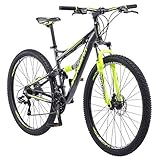
First, look for a mountain bike with narrower tires. This will make pedaling easier and help you go faster. You might also want to consider a hardtail mountain bike. The absence of a rear suspension makes the bike lighter and easier to pedal.
An XC mountain bike is a good option for road riding. These bikes are designed for cross-country riding, and they are lighter and faster than other mountain bikes.
If you mainly ride on pavement, a hardtail usually makes more sense than a full-suspension mountain bike. It wastes less energy, needs less maintenance, and feels more direct when you pedal.
Best MTB Setup for Road Riding
If you want your mountain bike to feel better on pavement, start here:
- Use semi-slick or slick tires
- Run pressure appropriate for your tire size and rider weight
- Lock out the suspension if your fork has that feature
- Remove unnecessary heavy gear
- Use a smoother, faster tread pattern
- Check saddle height and fit for better pedaling efficiency
Will riding on the road damage anything on the mountain bike?
The answer is maybe. The road can damage your bike if you are not careful. Potholes and other obstacles can cause flats, and the curbs can damage your wheels.
You should also be careful of debris on the road, which can cause a crash. And, of course, always wear a helmet when you are riding on the road.
With a little bit of knowledge and preparation, you can safely enjoy riding on the roads. Just be sure to take it slow at first and always stay alert.
In most cases, normal road riding will not damage a mountain bike. In fact, MTBs are built to handle more abuse than paved-road use usually throws at them. The bigger concern is not “damage from the road itself,” but faster wear on knobby tires and wasted energy if your setup is trail-focused.


Quick Tips
Always follow the road rules
When riding the one road, always remember to follow the road rules. This includes riding on the correct side of the road, using hand signals, and yielding to traffic.
Be visible
Make sure you are visible to other road users by wearing bright clothing and using lights at night.
Plan your route
Plan your route before you go so you know where you are going and what to expect. This will help you stay safe and avoid getting lost.
Pack your essentials
Bring a spare tube, a pump, and a few snacks with you in case you need them.
Lastly, make slight modifications but not occasionally when you plan to ride on the road.
A better long-term approach is to make small, smart changes if you ride on pavement often. A tire swap alone can make a mountain bike feel much faster and quieter on the road.


What To Consider When Riding an MTB on the Road
Handlebars
When riding mountain bikes on roads, use butterfly bars to allow for more versatility and comfort. When climbing uphill or feeling wrist pain from holding onto the handlebars too long in one position, it’s nice that these levers allow easy change posture.
That said, you do not have to replace your bars right away. Many riders do fine with flat bars. If comfort is the issue, first check your grip shape, stem length, and hand position before making a major cockpit change.
Tires
Knobby tires are ideal for rough terrain because of their extra grip, but they’re not the greatest choice for long trips. They are heavier and create more rolling resistance, quickly wearing out on a long journey.
If you plan to ride your mountain bike mostly on the road, consider getting semi-slick or slick tires. These have less tread and are lighter, so they are faster and easier to pedal.
This is one of the biggest upgrades you can make. Research on mountain-bike tire performance shows that tire characteristics affect rolling performance in measurable ways, which is why a faster tire can noticeably improve road feel (Macdermid et al., 2015).
Tire Pressure
To make your mountain bike faster on the road, you can lower the tire pressure. This will make the tires wider and provide more contact with the road, which will help you go faster.
Just be sure not to go too low, or you may risk getting a flat tire. The ideal pressure for mountain bike tires for the road is between 30 and 40 psi.
Note: The best pressure depends on your tire width, casing, rider weight, and road surface. On pavement, pressure that is too low can feel slow and squirmy, while pressure that is too high can feel harsh and reduce control. A practical starting range for many MTB riders on roads is still around 30 to 40 psi, but heavier riders, narrower tires, and smoother roads may need more, while wider tires and rougher roads may feel better with a bit less (Bertucci et al., 2013).
Saddle
Saddle pain is real, and it’s no fun to deal with. When choosing a saddle for your mountain bike, make sure to get one that is comfortable and will not cause you pain after long hours of riding. A good saddle will also have some padding to help absorb vibrations from the road.
Also, be sure to break in your saddle. Wearing seamless pants helps avoid friction.
Do not assume a softer saddle is always better. For longer paved rides, too much padding can sometimes create more pressure and rubbing. Fit matters more than bulk.
Suspension
On lengthy flat treks, the suspension may be a disadvantage. So, if you are looking for a mountain bike to take on the road, consider getting one with lockout suspension or no suspension. Lockout suspension allows you to turn off the suspension when you don’t need it, making pedaling easier.
Suspension shines on rough surfaces, but it can feel less efficient on smooth roads. Older research found that suspension helped reduce muscular stress and vibration in rough conditions, which is useful off-road or on broken pavement, but that does not automatically make it the best choice for smooth tarmac (Seifert et al., 1997)
Racks, Bags, and Panniers
Racks, bags, and panniers are great for carrying gear on long trips. They help keep your hands free and make packing easier.
When choosing a rack, be sure to get one that is compatible with your bike and can hold the weight of your gear. Bags and panniers come in different sizes and shapes, so be sure to choose one that will fit your needs.
When you use panniers, keep in mind that the rule of thumb is that when you need rear and front panniers, you’re carrying much weight! This, of course, slows down your bike.
Also, remember that your bike will be less maneuverable when you are carrying more gear. This is something to keep in mind when riding on the roads.
Are Mountain Bikes Good on Pavement for Commuting?
Yes, many mountain bikes are good on pavement for commuting, especially if your commute includes cracked streets, steep curbs, bad drainage covers, or mixed surfaces. A mountain bike can feel safer and more forgiving than a road bike in these conditions.
But for long, fully paved commutes, the tradeoff becomes obvious: you usually move slower and work harder. If your route is mostly clean pavement, a hybrid or gravel bike may give you a better balance of speed and comfort.
Hardtail vs Full-Suspension for Road Use
If you plan to ride on roads often, a hardtail is usually the better pick. It is lighter, simpler, and wastes less pedaling energy. A full-suspension bike can still work on roads, but it makes the most sense only if your route is rough enough to justify the extra comfort and control.
Mountain Bike vs Road Bike vs Gravel Bike vs Hybrid
| Bike Type | Best For | Road Speed | Comfort on Rough Roads | Versatility |
|---|---|---|---|---|
| Mountain bike | Mixed surfaces, rough roads, casual commuting | Lower | High | High |
| Road bike | Fast paved riding, long smooth roads | Highest | Lower | Lower |
| Gravel bike | Pavement plus light gravel | High | Moderate to high | High |
| Hybrid bike | City riding, commuting, fitness | Moderate to high | Moderate | Moderate to high |
If you already own a mountain bike, it often makes sense to use it on the road first instead of buying another bike right away. But if most of your riding is paved and you care about efficiency, a hybrid or gravel bike may be the sweet spot.
How Much Slower Is a Mountain Bike on the Road?
There is no single number because speed depends on fitness, tire choice, route, wind, and bike setup. But the general rule is simple: a mountain bike is usually slower on smooth roads because it has more rolling resistance and a less aerodynamic riding position than a road bike (Bertucci et al., 2013; Faulkner et al., 2021).
In real life, that means you may notice:
- lower cruising speed
- more effort to keep up on flat roads
- more drag from wide, knobby tires
- more comfort on bad pavement

Statistics and Facts: Are Mountain Bikes Good for the Road?
Performance Differences Between Mountain and Road Bikes
Mountain bikes feature wider tires, suspension systems, and a more upright riding position—ideal off-road but less efficient on pavement. In one controlled test, riders averaged 220 W on a mountain bike versus 246 W on a road bike during a 10-minute climb, with MTBs requiring frequent bursts above 300 W to overcome rolling resistance and technical effort.
Physiological Demands
Elite cross-country MTB racers sustain mean power outputs near 283 W and speeds of 19.7 km/h in off-road conditions, but these figures don’t directly translate to smooth-surface performance due to tire drag and bike weight (Granier et al., 2018).
Suitability for Road Use
While MTBs deliver extra comfort on rough or mixed surfaces, their knobby tires and suspension increase rolling resistance by up to 20%, making them slower and more taxing to pedal over long distances.
Summary Table: Mountain Bike vs. Road Bike for Road Use
| Feature | Mountain Bike | Road Bike |
|---|---|---|
| Tire Width | Wide (2.0″+), knobby | Narrow (23–28 mm), smooth |
| Suspension | Front/rear common | Rigid frame/fork |
| Riding Position | Upright | Aggressive, aerodynamic |
| Power Output (road) | Lower avg., more variable | Higher avg., steady |
| Rolling Resistance | Higher | Lower |
| Comfort on Rough Roads | High | Moderate |
| Efficiency on Pavement | Low | High |
What does research say?
Mountain bikes can be good for the road, but they are usually not the most efficient choice for smooth pavement. Research shows that rolling resistance in cycling changes with tire type, surface, and inflation pressure, which helps explain why knobby MTB tires feel slower on paved roads (Bertucci et al., 2013).
Research also shows that mountain-bike tire characteristics influence rolling performance, so changing from an aggressive knobby tire to a faster semi-slick can make a real difference in road feel (Macdermid et al., 2015).
Another reason MTBs feel slower on roads is posture. More upright positions are usually less aerodynamic than lower road-bike positions, and aerodynamics matter more as speed goes up (Faulkner et al., 2021).
At the same time, suspension can reduce vibration and muscular stress on rough surfaces, which helps explain why a mountain bike may feel more comfortable on broken pavement or mixed routes than a rigid road bike (Seifert et al., 1997).
Frequently Asked Questions
Can you put road tires on a mountain bike?
Yes, in many cases you can switch to semi-slick or slick tires that fit your rims and frame clearance. This is one of the easiest ways to make an MTB feel better on pavement.
Are mountain bikes bad for long road rides?
Not necessarily. They are not bad for long road rides, but they are usually less efficient. If comfort matters more than speed, they can still be a good fit.
Are mountain bikes good for fitness rides on roads?
Yes. In fact, because they can require more effort on pavement, some riders enjoy using them for fitness. You may just cover less distance for the same effort.
Do knobby tires wear out faster on pavement?
Yes, they often do. Pavement can wear down aggressive tread faster, especially if you ride hard on smooth roads often.
Final Thoughts: Are Mountain Bikes Good for the Road?
Are mountain bikes good for the road? Yes—for mixed or poor-quality surfaces—but if your ride is mostly smooth pavement and speed matters, you’ll expend more energy and ride slower on an MTB compared to a road bike. You can improve performance with narrower tires, suspension lockout, and optimized tire pressure, but a dedicated road bike remains the most efficient choice for pure on-road cycling.
References:
Bertucci, W. M., Rogier, S., & Reiser, R. F. (2013). Evaluation of aerodynamic and rolling resistances in mountain-bike field conditions. Journal of Sports Sciences, 31(14), 1606-1613.
Faulkner, S. H., Jobson, S. A., George, K., Day, S. H., Nevill, A. M., & Passfield, L. (2021). The effect of upper-body positioning on the aerodynamic-drag-to-metabolic-power ratio in cyclists. Medicine & Science in Sports & Exercise, 53(4), 838-844.
Macdermid, P. W., Fink, P. W., & Stannard, S. R. (2015). The influence of tyre characteristics on measures of rolling performance for mountain bike tyres. Sports Technology, 8(1-2), 61-70.
Seifert, J. G., Luetkemeier, M. J., Spencer, M. K., Miller, D., & Burke, E. R. (1997). The effects of mountain bike suspension systems on energy expenditure, physical exertion, and time trial performance during mountain bicycling. International Journal of Sports Medicine, 18(3), 197-200.