Best Rear Bike Racks in 2026
- Best Overall: Topeak Explorer Rack
- Best Alternative: Ibera Bike Rack
- Best Value for Money: Thule Tour Rack
- Best Eco-friendly Option: Planet Bike Eco Rack
- Best for Disc Brake Bikes: Blackburn EX-1 Rack
- Best for Touring: West Biking Carrier Rack
- Best Budget: Dirza Rear Rack
Looking for the best rear bike rack to haul your gear—whether you commute to work, run errands, or head out on weekend tours?
Cycling has become an essential part of peoples’ mobility. Bikes are now used for fitness, leisure, commuting, running errands, and more. This has prompted cyclists to look for reliable bike racks to suit their needs and carry their loads.
Yet many riders struggle to find a rack that offers stability, fits their frame, and holds the right weight without wobbling or damaging their bike.
A good rear bike rack can secure panniers, bags, baskets, or other cargo with confidence. As a commuter, you might worry your rack won’t clear your disc brake caliper. Or as a weekend tourer, you need a rack that holds 50+ lb on rough roads without bending.
Need a Few Practical Extras for Your Next Ride?
Browse cycling-related clothing and simple bike accessories that may help with comfort, visibility, storage, or everyday riding.
Paid links. As an Amazon Associate we earn from qualifying purchases.
An excellent rear bike rack can secure panniers, bags, baskets, and other items with ease.
We examined hundreds of models to come up with a list of some of the best rear bike racks on the market today. May this guide help you sort through loads of options to find the best fit for you.

18,058
Customer Reviews

14
Testing Hours

7
Tested Products

12
Sources Researched
7 of the Best Rear Bike Racks in 2026
Topeak Explorer Rack
Best Overall: Quality product with a variety of inclusive options
No products found.
The Topeak Explorer Rack is a versatile rear bike rack that fits a wide range of bike models. This is because of the Topeak’s flexible attachment arms and ample wheel clearance.
It is available in three style options – regular no-spring version, no-spring version for bikes with disc brakes, and spring version. The spring version makes securing smaller items easier with no bungees.
It also has three triangulated stays on each side for lightweight and durable support. This enables the Topeak rack to sustain a weight of 55 lbs. with stability and prevents the load from swaying side to side when riding.
The Topeak includes a welded-on taillight mount and nylon inserts on the locking nuts. These nylon inserts keep the nuts locked in place and help absorb road vibration.
Ibera Bike Rack
Best Alternative: Affordable, high-quality rack

- Made of TIG-welded, heat-treated, anodized alloy
- 55 lbs weight capacity
- Accommodates 26-29 inches frames
- Disc-brake compatible
The Ibera Bike Rack is an affordable universal fit rack. It is disc-brake compatible and adjustable to fit disc frames between 26″-29″. The bottom rods are 8″ apart, so they can accommodate even the broadest fat tires with ample clearance. This rack can also hold weight up to 55 lbs. Despite this weight capacity, this rack is not built to carry people and baby seats.
Design-wise, the Ibera is a decent, lightweight, and solid bike rack. It offers plenty of space to secure velcro straps and bungee cords for extra weight capacity. It is also a reflector and taillight attachable for an additional security feature.
Like any other bike rack, the Ibera also has its drawbacks. It is compatible with panniers with vertical brackets on the bottom. Buying panniers, bags, and baskets from the same brand would be better if you want a perfect fit. Although it is a universal fit rack, some bikes might need minor adjustments to make this work.
Thule Tour Rack
Best Value for Money: Versatile and nifty rack for any bike

- Made of aluminum and nylon material
- 25 lbs weight capacity
- Tire clearance up to 29-inch high and 2.5-inch wide
- Attachable to both front and rear area

The Thule Pack’ N Pedal Tour Rack is a great option for bikes with no rack mounts. Rather than eyelets, this rack uses a ratchet strap system to attach to the bike frame. It uses rubberized grips that keep the rack stable even when weighted down with bags.
The unique attachment system also raises the mounting points, allowing ample clearance.
When it comes to loading, the Thule rack has a max weight capacity of 25 lbs. Yet some users observed that it could carry up to 39 lbs. using panniers, or 55 lbs when loading on top.
Adding to its impressive features, this rack has a built-in security feature. It needs a release key to remove the rack from the frame, which keeps it secure from possible theft. If preferred, the Thule rack can be attached to the front fork for a front rack style.
Planet Bike Eco Rack
Best Eco-Friendly Option: Sustainable and recyclable choice

- Made from oversized 6061 tubular aluminum
- 55 lbs load capacity
- Fits 26-inch, 700c, 650b, and 29-inch bike tires
- Weighs 1.5lbs
The Planet Bike Eco Rack is an excellent rack for commuting. It is a simple design that works well with a lot of bikes. This clean and minimalist rack makes attaching standard cargo carriers easier. It is also built with open side rails to accommodate standard panniers, baskets, or bags.
The Planet Bike rack is easy to install even by riders who have no mechanical experience. This is because it includes pre-installed hardware for a no-fuss installation. It also comes with p-clips to aid installation if your frame does not have eyelets.
It has a weight capacity of 55 lbs. which is plenty for a commuter rack. Though it is not compatible with disc brakes, it does an excellent job with electric and hybrid bikes.
What makes the Planet Bike Eco bike rack unique is its sustainable practices. Their racks are fully recyclable, and they donate 1% of revenue to environmental causes.
Blackburn EX-1 Rack
Best for Disc Brake Bikes: No-fuss option for disc brakes

- Made of 6061 alloy
- Disc or non-disc options
- 40 lbs load capacity
- Fits 29ers and 700c bike wheels
The Blackburn Expedition Rear Rack is available in two options, the EX-1 Disc rear rack, and the EX-1 rear rack. Both are compatible with 29er or 700c bike wheels, though they can fit smaller wheels. The main difference between the two is the first is disc brake-compatible while the other is not. The disc brake rack is also compatible with frame mounts and rear dropouts.
The build quality of these aluminum racks is sturdy enough to carry a weight capacity of 40 lbs. The rack features three stays on each side, providing stability and durable support. It is also suitable with Copilot child seats for kids under the stated weight capacity.
This is a decent option if you are looking for affordable but sturdy rear racks for your disc brake bikes.
West Biking Carrier Rack
Best for Touring: High-capacity universal adjustable cargo rack

- Made of aircraft-grade aluminum alloy
- Fits 20 cm–73.6 cm frames
- 310 lbs load capacity
- Extended protective flanks
West Biking carrier rack is built to carry heavy loads—up to 310 lb—without flexing. You can haul bulky camping gear or grocery bags confidently, thanks to the 3-point design that keeps weight balanced. The aircraft-grade aluminum frame and solid steel bearings feel sturdy, and the stainless steel, shock-proof screws stay tight on rough roads.
Because it fits frame tubes from 20 cm to 73.6 cm, it works on most adult bikes—road, mountain, or hybrid. Simply adjust the front and rear supports to clear disc brakes or fit tall panniers. The extended flanks prevent your bags from brushing the spokes, and the detachable reflector boosts visibility in traffic.
If you ride a fat bike, the support rods expand to accommodate tires up to 4.6″ wide. Installation takes about 15 minutes: clamp the supports around your seatpost (no eyelets needed) or slide into existing eyelets, then tighten all bolts securely. For optimal performance, check screws after a few rides.
This rack offers one of the highest load capacities available—ideal if you need a reliable, heavy-duty cargo solution for commuting or touring.
Dirza Rear Rack
Best Budget: Greater weight capacity in a budget
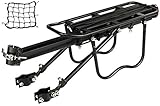
- Made of aluminum alloy
- Fits 18-27.5 inches MTB and road bike types
- 115 lbs load capacity
- Includes bike cargo net and reflector
- Does not fit suspension type bike
At a low price, you can avail of a good quality product. The Dirza rear rack is the cheapest rack on this list. It can hold up to 120 pounds of cargo, which is more than enough for a budget-type rack. It also comes with a reflector, a cargo net, and a bungee-like wire to secure your cargo.
It has W-shaped bars to prevent the pannier from hitting the tires. The rods also have an adjustable shelf and bottom fit 18″-27.5″ MTB and road bike types.
Although there is so much to love about this bike rack, it also has many limitations. It does not fit suspension bikes, fat tires, women’s cruiser bikes, kids’ bikes, bike seats, and unusual frames.

Who Should Consider a Rear Bike Rack?
- Daily Commuters: If you carry a laptop, work clothes, or groceries, choose a rack with stable mounting (e.g., Topeak Explorer or Planet Bike Eco).
- Weekend Tourers: Look for a high weight capacity (110 – 125 lbs) and durable material. Ensure it fits your tire size and brake type.
- E-Bike Riders: Confirm the rack clears your rear derailleur and brake mount. Many e-bikes weigh more, so choose a rack rated for at least 60 lbs.
- Disc Brake Cyclists: Only select racks labeled “disc-brake compatible” (e.g., Topeak’s disc version, Ibera, Blackburn EX-1 Disc).
- Budget-Conscious Riders: If price is paramount, Dirza offers high capacity but has more fit limitations. Consider potential future frame upgrades.

How to Use Rear Bike Rack

Bungee Cords
Bungee cords are a must when you have a rear rack unless you have a spring version. These are the rubberized cords you use to secure your load so that they do not fall while you are riding. You can buy them in your local bike shops or from the same manufacturers where you bought your rack.
If cords are too loose, your load can shift on bumpy roads. Double-check tension before you ride.
Panniers
Panniers are great options for carrying groceries, bike essentials, and personal effects. They make mobility easier when riding. You won’t have to worry about balance as long as the loads are evenly distributed.
Good quality panniers are well-made and balanced. They should be sturdy and weather-proof to protect your belongings from unfortunate incidents.
When buying a pannier, it is always recommended to buy from the same manufacturer where you got your rack. Although many panniers are universal fit, there are times that they won’t be able to fit together.
If your rack has no lower rail, secure panniers with a bungee from below.
Baskets
Depending on their use, you can attach a basket in the front or rear part of your bike. If you use your baskets for delivery or grocery shopping, you might want to put them on your rear rack. Unlike front baskets, rear baskets can carry more groceries. It won’t also hinder your steering and balance.
Heavy baskets can make steering wobbly—avoid overloading.
Trunk Bags
Trunk bags sit on the top of your rack and are better options than backpacks. They are available in different sizes and styles, so it’s up to you to choose what goes best with your rack.
It is crucial to consider the weight capacity and style of your rack when choosing.
Some trunk bags are easier to install, while others need straps and bungee cords.
Trunk bags keep essentials easy to reach without removing panniers.
Extra Seat
An extra seat will be impossible to fit if you want to install a rear rack unless your bike is a two-seater. Some riders use their rear rack as a seat or child carrier, but this is dangerous and not recommended.
Racks are not made for passengers—this can damage the rack or cause an accident. Avoid using as a seat.

What to Look for When Buying Rear Bike Racks
Material
The materials used for making bike racks are the same materials used for bike frames. They could either be aluminum, steel, or titanium. Steel racks are known for their durability but are heavier and can add more weight to your bike.
Titanium racks are the best when you are looking for a top-of-the-line rack. It is very durable, lightweight, and corrosion-resistant. It is also expensive and can cost as much as an entry-level bike.
The most common material used for bike racks is aluminum. It is lightweight, flexible, and strong enough to last you a long time. It is also affordable and won’t cost you an arm or a leg to buy.
If you ride daily and care about every ounce, choose aluminum. If you tour with 50 + lbs frequently, consider a steel or titanium rack.
Weight
Lightweight bike rack materials are the usual choice for cyclists. They do not add more weight to your bike or cargo.
- Rack Weight: Heavier racks often support more weight (110 – 125 lbs).
- Load Capacity: Match your average load (e.g., daily commute ~ 20 lbs; touring ~ 60 lbs).
A lightweight rack with high capacity may flex on rough roads. Choose based on terrain.
Rear Bike Rack and Disc Brakes
Not all rear bike racks are compatible with bikes with disc brakes. If your bike has a disc brake, you can ask your local bike shop or manufacturers for disc brake compatible options. Some choices you might want to try are the: Topeak, Ibera, and Blackburn rear racks.
Tire Size Compatibility
Check if rack fits 26″, 27″, 700c, or 29″ wheels. Some racks list “fits 26″–29″” but require adjusting stays. Confirm max clearance (e.g., wide fat tires may not fit).

How to Install a Rear Bike Rack
1. Identify Mounting Points
- Look for eyelets on chainstays or seatstays near the rear dropouts.
- If no eyelets, you’ll use P-clips or ratchet straps (as on Thule Pack’ N Pedal).
2. Attach Lower Stays
- Slide the lower rack arms into the frame’s eyelets.
- Secure with the included bolts.
- Tip: Tighten bolts snugly with an Allen wrench. Avoid overtightening, which can strip threads.
3. Position Upper Stays
- Adjust the length of the upper stays to reach the rack’s upper brace point (seatstay or rack boss).
- Use washers or spacers if needed to clear disc brake calipers.
- If you mount the rack too high, panniers may rub against your wheels. Test clearance by rotating the wheel by hand.
4. Level & Align
- Ensure the rack is level from side to side; use a small bubble level or eyeball it.
- Tighten all bolts incrementally—alternate tightening to keep it square.
5. Load Test
- Put a modest load (10 – 15 lbs) in your panniers or trunk bag.
- Ride slowly in a flat, open area to test stability.
- If you hear creaks or see flex, stop and retighten bolts. Consider adding threadlocker if bolts back out on bumpy roads.
Rear Bike Rack Installation Tips
Some things to watch out for when installing your rear bike rack includes the following:
- Check Heel-Pannier Clearance: On each pedal stroke, ensure panniers don’t hit your heels. If they do, shift panniers forward or choose a rack with diagonal stays.
- Secure All Bolts: Bolts can loosen over time. Check tightness every 50 mi, especially after the first week of riding.
- Use Locknuts or Threadlocker: For racks on rough roads, upgrade to locknuts or add blue threadlocker to bolts—prevents rattling and loosening.
- Mind Your Frame Material: On carbon frames, never over-torque P-clips or bolt on eyelets—this can crack the tube. Ask a bike shop if unsure.
- Balance Your Load: Keep weight centered and low. Heavy items at the top of a rack raise your center of gravity and may affect handling.
- Protective Spacers: If your stays rub paint or brake mounts, use small rubber grommets or washers to prevent scratching.

FAQs
How much weight can a rear bike rack hold?
The average weight a rear bike rack can hold is between 30-90 pounds. However, some rear racks like Dirza can carry up to 120 pounds.
Will a rear rack work on my e-bike?
Yes—most racks fit e-bikes, but confirm your rear dropout strength. E-bikes weigh more, so choose a rack rated for at least 60 lbs. Consider aluminum racks for lighter weight or steel racks for maximum load.
Are rear racks compatible with disc brakes?
Not all racks clear the disc caliper. Look for “disc-brake compatible” in specs. Examples: Topeak’s disc version, Ibera, Blackburn EX-1 Disc. If unsure, measure clearance behind your caliper before purchasing.
How do I know if my bike frame supports a rear rack?
Check for frame eyelets (small bolts) near the rear dropout. If you have eyelets, most racks install easily. If not, use a rack with P-clips or ratchet straps (e.g., Thule Pack’ N Pedal). Consult your local shop for carbon or unusual frames.
Can I use a rear rack on any bike tire size?
Only if the rack lists support for your tire size (26″, 27″, 700c, 29″). Some racks fit multiple sizes but may need adjustment stays. Fat-tire bikes (≥ 2.2″ wide) often require specialized racks with wider platform and mount spacing.
How does added weight affect bike handling?
Heavy loads shift your center of gravity and can slow your steering response, especially at low speeds. Keep the rack load balanced—heavy items close to the frame and evenly distributed left to right.
Are panniers universally compatible?
Many panniers are “universal,” but some need specific bracket shapes. If possible, buy panniers and rack from the same brand. A frame-mounted lower rail also helps stabilize panniers.
Conclusion
Getting a rear bike rack is an excellent bike upgrade. It makes the ride easier and hassle-free, especially for commuting and touring. It is also helpful when using bikes for delivery or occasional trips to the grocery store.
If you are still undecided on what you want to buy, then the Topeak Explore rack might be what you need. It is an all-around and dependable rear bike rack that can accommodate a lot of bikes and loads.
Ultimately, match your choice to your riding style: commuters value ease of installation and moderate capacity (25 – 55 lbs), while weekend tourers need racks rated 100 + lbs for heavy panniers.