Best Hydration Packs for Mountain Biking
Best Hydration Packs for Men
- Best Overall: Camelbak M.U.L.E. 12L
- Best Alternative: Osprey Raptor 14L
- Best Value for Money: Evoc Trail Pro 10L
- Best Lumbar Style Hydration Pack: Camelbak Skyline LR 10L
- Best Ultralight Hydration Pack: CamelBak Lobo 10L
- Best Hydration Hose System: Thule Vital 8L
Best Hydration Packs for Women
- Best Choice for Big Days: Osprey Raven 14L
- Best Daypack: Gregory Mountain Maya 10L
- Best Lumbar Style Hydration Pack: Camelbak Solstice LR 10L
- Best Waterproof Hydration Pack: Leatt Hydration Pack Lite 1.5
Since you are reading this article, I’m sure that you’re looking for the best way to keep yourself hydrated during your rides.
And perhaps bring more snacks, gears, and other valuables.
Read also: What To Eat and Drink During Bike Rides
Well yes, a hydration pack is the best choice and the most convenient for carrying water with extras if you plan long hours on the trail.
Need a Few Practical Extras for Your Next Ride?
Browse cycling-related clothing and simple bike accessories that may help with comfort, visibility, storage, or everyday riding.
Paid links. As an Amazon Associate we earn from qualifying purchases.
So to help you with your choice, we have reviewed and summarized the best hydration packs for mountain biking that can be found in the market today.
If you are also considering a backpack, check out our article on the best mountain biking backpacks. Or the best bike water bottle if you are looking for one.

19,496
Customer Reviews
12
Testing Hours

10
Tested Products
15
Sources Researched
- Best Hydration Packs for Mountain Biking
- 10 Best Hydration Packs for Mountain Biking
- Best Overall: Camelbak M.U.L.E
- Best Alternative: Osprey Raptor 14
- Best Value for Money: Evoc Trail Pro 10L
- Best Lumbar Style Hydration Pack for Men: Camelbak Skyline LR 10
- Best Ultralight Hydration Pack: CamelBak Lobo Hydration Pack
- Best Hydration Hose System: Thule Vital 8L
- Best Choice for Big Days (Women): Osprey Raven 14L Women's Hydration Backpack
- Best Women's Daypack: Gregory Mountain Maya 10L Women's Daypack
- Best Lumbar Style Hydration Pack for Women: Camelbak Solstice LR 10
- Best Waterproof Hydration Pack: Leatt Hydration Pack Lite 1.5L
- Benefits of MTB Hydration Pack
- What to Look for When Buying a Hydration Pack for Mountain Biking?
- Most Commonly Asked Questions
- Conclusion on the Best Hydration Pack for Mountain Biking
10 Best Hydration Packs for Mountain Biking
Best Overall: Camelbak M.U.L.E

- Material: coated ripstop nylon
- Volume: 12L
- Gear capacity: 9L or 540 cu.in.
- Water capacity: 3L or 100oz (includes a Crux reservoir)
- Weight: 1.37 lbs
- Includes helmet holder
- Dimensions: 17.9 x 8.7 x 8.9 inches or 45.5 x 22 x 22.5 cm
Indeed Camelbak M.U.L.E. was designed with its tag. It has everything you need and nothing you don’t. It is big enough to carry enough water and many gears, but it is still lightweight and won’t get in your way.
The M.U.L.E. pack also features a magnetic tube trap which returns quickly into place to help you drink without taking your eyes off the trail. Also, the included Crux reservoir delivers 20% more water per sip. It also has an ergonomic cap and a self-sealing bite valve.
Air channels were also added to ensure your jersey stays dry and cool.
Best Alternative: Osprey Raptor 14

- Material: 210-denier double-diamond nylon ripstop/420-denier nylon packcloth
- Volume: 14L
- Gear capacity: 11.5L or 701 cu.in.
- Water capacity: 2.5L or 85oz (includes Osprey Hydraulics LT 2.5L reservoir)
- Weight: 1.875 lbs or 850 g
- Includes helmet holder
- Dimensions: 19 x 9 x 10 inches or 48.26 x 22.86 x 25.4 cm

This Raptor 14-liter hydration pack features a BioStrech harness and hip belt, which gives you maximum comfort while on the ride. Another good feature is the magnetic disk for hose attachment. It gives you easy access to the bite valve and, at the same time, keeps it from flopping around.
The bag also comes with a lid lock helmet carrier for a secured helmet hold. To keep things organized, stretch mesh divisions are in the main compartment. It comes with a removable tool roll for added tool management. Zippered pockets on the hip belt are perfect for your snacks, phone, and other valuables.
Best Value for Money: Evoc Trail Pro 10L

- Material: nylon P200D aero flex
- Volume: 10L cargo
- Gear capacity: 7L /1037 cu.inches
- Water capacity: 3L /100oz (reservoir not included)
- Weight: 900 g
- Includes helmet holder
- Dimensions: 26 x 50 x 9 cm
Evoc Trail Pro 10L brings high-end protection to day tours and trail riding in an extremely light package. Its integrated LITESHIELD PLUS back protector soaks up impacts—and if it ever takes a hard hit, the free crash-replacement guarantee has you covered.
Adjustable Brace Link shoulder straps and wide hip fins deliver a snug, body-hugging fit that resists bounce on technical descents. Despite offering 10 L of cargo space plus a dedicated 3 L hydration compartment, the pack tips the scales under 1 kg.
An intuitive 2-step zip system, dedicated tool pocket, and multiple loops keep essentials organized and within reach. For riders seeking top-tier back protection, smart storage, and superb value, the Evoc Trail Pro 10L stands out.
Best Lumbar Style Hydration Pack for Men: Camelbak Skyline LR 10

- Material: 70-denier/210-denier diamond ripstop nylon; 210-denier high-tenacity nylon
- Volume: 10L
- Gear capacity : 7L or 420 cu in
- Water capacity: 3L or 100 oz (included Lumbar Reservoir w/ integrated compression)
- Weight: 1.43lb or 650g
- Includes helmet holder
- Dimensions: 18.5 x 9.06 x 2.36 inches or 47 x 25 x 18 cm
The lumbar reservoir with integrated compression is the primary feature of the Camelbak Skyline LR 10. The bulk of the pack’s weight is shifted near the lower back, which gives you an advantage as this gives you more stability on rough trails.
Other good features include enough pockets and a roll tool organizer to accommodate your biking gears and tools. It also comes with an attachment for a full-face helmet and armor.
In addition, Skyline LR 10 has a magnetic tube trap to keep the hydration hose from swinging around. The back panel is also ventilated with a mesh harness to keep you cool and dry.
Best Ultralight Hydration Pack: CamelBak Lobo Hydration Pack

- Material: 100-denier nylon / 210-denier nylon
- Volume: 9L
- Gear capacity : 6L or 360 cu in
- Water capacity: 3L or 100 oz (includes Crux reservoir)
- Weight: 480 g
- Includes helmet holder
- Dimensions : 18 x 8.3 x 7.5 inches or 46 x 21 x 19 cm
Camelbak Lobo features back panel channels and ventilated harness. These are lightweight and breathable to keep you cool and comfortable, especially on sunny weather cycling.
To help you organize your gears, this pack also provides secure-zip pockets, tool roll, and exterior helmet carry.
Camelbak Lobo also has an adjustable sternum strap and a removable stability belt that offers a range of fitting adjustments.
And for those who advocate recycling, Camelbak is proud to announce that this product is made partially of post-consumer recycled materials.
Best Hydration Hose System: Thule Vital 8L

- Material: Nylon
- Volume: 8L (also available in 6L and 3L- capacity pack)
- Gear capacity : 5.5L or 335 cu.in.
- Water capacity: 2.5L or 85 oz (includes 2.5L Hydrapak reservoir)
- Weight: 1.21 lb or 550 g
- Helmet holder: none
- Dimensions: 23 x 10 x 44.5 cm / 9.1 x 3.9 x 17.5 in
The best feature of Thule Vital is its “ReTrakt” magnetic hydration hose return system. This keeps the hose from being loose, and it makes hydration hands-free.
It also has pockets on the waist belt. You don’t have to remove your pack to get your tools or snacks.
Additional features include a tail light attachment which adds to your safety. You can also fasten a shock pump or tire pump as it has an interior loop specially designed for these tools.
Best Choice for Big Days (Women): Osprey Raven 14L Women’s Hydration Backpack

- Material: 210-denier double-diamond nylon ripstop / 420-denier nylon packcloth
- Volume: 14L (also available in 10L-capacity backpack)
- Gear capacity : 11.5L or 701 cu in
- Water capacity: 2.5L or 85 oz (includes Osprey Hydraulics LT 2.5L reservoir)
- Weight: 1.63 lb or 740 g
- Includes helmet holder
- Dimensions 17.9 x 8.7 x 8.9 inches / 45.5 x 22 x 22.5cm
One awesome feature of the Raven 14 is the “winged” shoulder straps. It wraps to the shape of your shoulder, which gives you superior stability. The back panel is also made of mesh-covered foam to keep you well ventilated.
With its 14 L capacity, you can reach far as it accommodates many gears and supplies on the trail ride. Another feature is a removable roll-out tool pouch which is included in the zippered lower pocket. This makes your tool organization a lot easier.
The Raven 14 is also made with a reflective patch and blinker light attachment for your safety.
Best Women’s Daypack: Gregory Mountain Maya 10L Women’s Daypack

- Material: nylon, 210D honeycomb CryptoRip HD Nylon, 420D High-Density Nylon
- Volume: 10L (also available in 16L, 22L, 30L and 40L - capacity daypack)
- Gear capacity: 7L or 420 cu in
- Water capacity: 3L or 100 oz ( reservoir not included)
- Weight: 1.45 lbs or 660 g
- Helmet holder: none
- Dimensions 17.50 x 9 x 7 inches / 44.5 x 22.9 x 17.8 cm
Gregory Maya Daypack features a wraparound body design. It comes with BioSync adjustable suspension and sleek materials that flexes and moves with your body. This helps you continue moving unrestricted.
Aside from the inner pocket, the pack is enclosed with hip belt pockets, dual side pockets, and a front pocket to accommodate more of your loads.
It also has a “quick-stow system” on the shoulder harness to ensure your sunglasses are secured and scratch-free.
Another good feature is the speed clip hydration hangar that fits with Gregory’s 3D Hydro reservoir, which can contain 3 L for your hydration.
Best Lumbar Style Hydration Pack for Women: Camelbak Solstice LR 10

- Material: 70-denier / 210-denier diamond ripstop nylon; 210-denier high-tenacity nylon
- Volume: 10L
- Gear capacity: 7L or 420 cu in
- Water capacity: 3L or 100 oz (includes Lumbar Reservoir)
- Weight: 1.43 lb or 650 g
- Includes helmet holder
- Dimensions: 18.5 x 9.06 x 2.36 inches / 47 x 25 x 18 cm
The Solstice pack offers a lumbar reservoir that situates the bulk of the weight on your hips. As the center of gravity is lower, stability is excellent. It also lessens the strain from your shoulders and back.
The main compartment holds zippered pockets for easy organization of tools. Using the pockets on the waist belt, phones, snacks, and other devices can be easily accessed.
Another feature of this pack is the dual wing belt. The inner belt holds the weight to the waist, and the outer belt compresses the cargo fit to your body.
Best Waterproof Hydration Pack: Leatt Hydration Pack Lite 1.5L
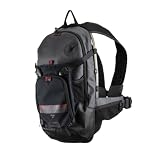
- Material: Polyester, Thermoplastic Polyurethane (TPU)
- Volume: 10L
- Gear capacity: 8.5L
- Water capacity: 1.5L or 50oz bladder
- Includes helmet holder
- Dimensions: 17.72 x 11.81 x 2.76 inches
The Leatt Mountain Lite 1.5 Graphite blends minimal weight and high functionality into one sleek protector pack. Its chest-harness design locks the pack firmly in place—no shoulder-strap bounce—while the durable shell withstands trail scrapes.
You can insert a CE-certified impact protector (sold separately) for added safety, and the integrated carrier holds full-face helmets or neck braces when you’re not wearing them.
Despite offering a full 10 L of cargo space plus a 1.5 L hydration bladder compartment, it tips the scales under 1 kg, making it a standout for day tours where every gram matters. Intelligent pocket layouts keep tools, snacks, and small items organized and within easy reach.
For riders who demand protective performance without bulk, the Leatt Mountain Lite 1.5 delivers.

Benefits of MTB Hydration Pack
Mountain biking is a pretty vigorous activity. You will sweat a lot, and time after time, you feel the thirst. Water bottles are handy as they will just be pinned on the bike frame. However, water bottles can only contain as much water. It will not be enough to quench a thirst for a long bike ride a lot of times. And here comes the hydration packs to cater to this problem.
Hydration packs, in different capacities, allow you to carry water as much as 3 liters. As the pack is mounted with a hose connected to the bladder, you can easily take a sip anytime without having to stop and even hands-free! This saves you a lot of time.
Hydration packs also allow you to carry gears, tools, snacks, and other supplies you need along the trail—the compartments and pockets of the pack help in the organization. If you’re thinking of carrying a heavy pack because of these features, well, not to worry. These packs are made of lightweight materials. Back panels and hip belts are also ventilated to keep your back dry and cool.
With all these features, you would not be slowed down on the trail. You can still enjoy the ride without feeling a burden on your shoulder.

What to Look for When Buying a Hydration Pack for Mountain Biking?
Hydration Capacity vs. Sweat Rate
Choose a bladder size that matches your fluid loss (approx. 0.5 L/hour for moderate rides; up to 2 L/hour in hot or intense conditions).
Tip: If you plan multi-hour or remote trips, aim for 3 L or more and confirm you can refill easily on the trail.
Gear Capacity and Accessibility
For the gear capacity, consider the tools and other necessities you need to carry. Some carry with them a spare rear derailleur and a space blanket too. Others need not to bring spare gears. Same goes for foodstuffs. So evaluate how much space on the pack you need. Most riders will go the 7-liter cargo-carrying packs. Note that more space equals more fabric and more weight to carry.
Look for separate tool rolls, zip pockets, and quick-stow pouches for snacks, phone, and repair kits. Fumbling through one big compartment can waste precious time when you need a quick fix.
Fit, Ventilation and Comfort
Most of the hydration packs come as “one size fits all.” Because of this, they are highly adjustable and can fit a wide range of shapes and sizes. But still, it is always recommended to try and fit the packs before purchasing.
Ensure the pack fits your torso length; adjustable straps and BioStretch harnesses help prevent pressure points.
Another thing to check is the sternum strap and hip belt. This is to help stabilize the weight of the load. Look also for packs with channels, or even better if it is with a suspended mesh back panel. Mesh channels and suspended back panels keep airflow against your spine to reduce sweat buildup.
Back System
Too short or too long packs can leave back pain. So check for packs that come with an adjustable back panel. Ventilated back panels are highly recommended to keep your back dry. You might also want to consider choosing bags that feature a removable spine protector.
This means excellent points for packs with easy-to-access pockets for phones and other tools you will likely use most of the time.
Weight Distribution & Stability
Lumbar or hip-belt reservoirs lower center of gravity, increasing stability on rough terrain. A snug sternum strap reduces shoulder fatigue on long climbs.
Hose Retention and Ease of Use
Magnetic tube traps or clips prevent the hose from flapping, so you can drink without breaking stride. Consider packs with quick-release fittings if you need to detach the bladder for cleaning.

Most Commonly Asked Questions
How do you stay hydrated on a mountain bike?
First thing is never to start a ride dehydrated. 500 ml of water 30 minutes before the ride is a good start. During the ride, sipping water for the first 30 minutes plus three gulps from time to time will keep you hydrated. Electrolyte tablets, though not necessary, can help you retain the fluids you are taking. Apart from that, it also adds flavor to your water. One tablet for 500 ml is already good.
How much water should you drink while biking?
In general, for every hour of vigorous riding, you should drink about 24oz of water. But of course, for some, that is not sufficient. So we suggest that you try out and note how much fluid is best for you. Keep in mind that the absorption of fluids in our body is lower during strenuous physical activity, especially in the heat. So it’s best that you drink 7 to 10oz water every 10 to 20 minutes.
What should I drink after cycling?
Remember that after a ride, especially in a long one, your body loses a lot of fluid. Water and electrolyte drink is still the best beverage to rehydrate.
Electrolyte drinks provide potassium, sodium, and other electrolytes.
What do pro cyclists drink while riding?
Plain water is an essential drink for cyclists. But for longer rides, electrolyte drink is a good supplement to water. Another alternative is hydration tablets or mix. It contains 3 to 4% carbohydrates and electrolytes. Carbs help in the transport of water and sodium ions in the small intestine.
The next drink is a carb-focused drink mix. These drinks contain more carbs but the same sodium content as a hydration mix.
Is Coke good for cycling?
If Coke is diluted, it acts as a good sports beverage. 50% of Coke with another half of Gatorade can give you about 8.7% sports drinks. Alternatively, two parts of Coke and one part water will provide you with a 7.3% sports drink.
It is also very possible that Coke’s caffeine may boost your performance by enhancing muscle function, especially during the final stage of prolonged exercise. However, Coke’s small amounts of caffeine would probably not rouse you if you are a regular caffeine user.
Nevertheless, it doesn’t mean that Coke is a good drink for everyday use.
How much water should I drink per hour on a mountain bike?
Aim for 0.5 L/hour in moderate conditions; increase to 1–2 L/hour in heat or on strenuous rides.
Can I clean my hydration bladder in the dishwasher?
Most reservoirs are top-rack safe—check manufacturer guidelines before use.
Conclusion on the Best Hydration Pack for Mountain Biking
Choosing the best hydration pack for mountain biking means balancing capacity, comfort, and organization. Consider your typical ride length, terrain, and personal sweat rate. Again, we consider the Camelbak Mule as the best hydration pack for mountain biking. It is lightweight and has an ergonomic design made from high-quality materials. Plus a good balance between its water and gear capacity.
Have a fun ride!
Reference: Kreider, R. B., et al. (2023). Total energy expenditure and ad libitum fluid/nutrient intake during a 24-hour mountain-bike event: A case study. Journal of Science and Medicine in Sport. https://pubmed.ncbi.nlm.nih.gov/36931326/