Our Top Picks:
- Best Overall: Schwinn Bonafide Hardtail Mountain Bike
- Best Alternative: Schwinn High Timber Mountain Bike
- Best Value for Money: Hiland Mountain Bike
- Best for Women: Mongoose Flatrock Mountain Bike
- Best Entry-Level: Huffy Hardtail Mountain Bike
There are many bike brands with new hardtail mountain bikes each year. With so many options, picking the right bike can feel tough.
However, you can narrow your choices with two simple ideas: RELIABLE and REASONABLE.
This means choosing a bike that meets your needs without breaking your budget.
What is a reasonable price? It depends on your own situation.
Need a Few Practical Extras for Your Next Ride?
Browse cycling-related clothing and simple bike accessories that may help with comfort, visibility, storage, or everyday riding.
Paid links. As an Amazon Associate we earn from qualifying purchases.
For me, it means getting the best quality I can for the least amount of money. You can find several hardtail mountain bikes for under $500.
But in case you change your mind and wish to get a full suspension bike, you can check out my article on the best full suspension mountain bike on a budget. Check out also our articles on best beginner mountain bikes or best mountain bikes under 500 dollars.
Here are the best hardtail mountain bikes under $500 that you would not like to miss.

10,602
Customer Reviews
14
Testing Hours

5
Tested Products

9
Sources Researched
5 of the Best Hardtail Mountain Bikes Under $500
Best Overall: Schwinn Bonafide Hardtail Mountain Bike
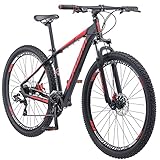
- 17-inch aluminum frame (one size)
- 29 by 2.25-inch knobby tires
- Schwinn front suspension fork
- 24-speed with Shimano EZ fire trigger shifters and Shimano derailleurs
- Mechanical disc brakes
- Schwinn alloy crankset

This bike from Schwinn has a stunning and modern look. In terms of performance, the Bonafide is light, nimble, and comfortable. This is mainly because the bike frame is made of lightweight aluminum and the bike has an effective shock absorber.
In addition, the 29-inch tires allow you to roll over obstacles with ease. When it comes to speed and control, the gear changes effortlessly with just a flick of the thumb. The disc brakes has all-weather stopping power, not mention that it costs less to maintain. So you don’t have to worry about your safety and just have fun.
The Bonafide is the one of the best hardtail MTB from the popular Schwinn brand. If you want a bike that needs little maintenance and delivers a fun ride, this might be a good pick—all for under $500.
Best Alternative: Schwinn High Timber Mountain Bike

- 17-inch aluminum/steel frame
- 24/26/27.5/29-inch wheel size
- Front suspension
- 7-21 speeds option with Shimano twist shifters and derailleurs
- Mechanical disc brakes
- Alloy crank
- Quick release seatpost and front tire hub
The High Timber bike comes with an aluminum or steel frame option. You can choose the lighter aluminum frame for an easier climb or choose the heavier steel frame for a more stable downhill ride.
There are also different sizes to choose from. This is advantageous since having the right bike size makes riding more comfortable. It also comes with a 7 to 21-speed option. You can get a bike with several gears that would fit your biking skill and terrain choice. With 21 speeds, you have more range for pedaling power.
Shifting is easy with the twist shifters. You can change gears with your hands firmly holding the grips. In this way, you can avoid losing control of the bike while shifting on rocky or muddy terrain. The linear v-brakes are also reliable for stopping anytime and anywhere. But if you want a stronger brake system, there is a more expensive option with mechanical disc brakes.
The bike is sturdy and can ride down any terrain without causing problems. Overall, the High Timber is a solid entry-level bike that you could ride for years.
Best Value for Money: Hiland Mountain Bike

- Ultralight aluminum frame with internal cabling
- 18-inch frame size
- 27.5 by 2.10-inch Kenda tires
- Quick release front and rear wheel hubs
- Lockout front suspension fork
- 21-speed with Microshift TS38 and Microshift M21 rear derailleur
- Hydraulic dual disc brakes
- Excellent for both road and off-road cycling.
The Hiland mountain bike comes with an aluminum frame which makes it light. With its weight, pedaling uphill is easier. Also, the internal cabling makes the bike look neat simultaneously; it prevents the cables from rubbing off the frame.
The front suspension fork has a lockout. With this, you can still ride well off-road without sacrificing much speed while riding on flats.
The brakes are powerful and efficient. Even when the disc brakes are wet and muddy, it still bites hard.
This bike also comes with 27.5×2.10 inches Kenda tires. These tires are neither too thin nor too thick, making them perfect for any terrain. Wheel maintenance is convenient with quick-release hubs on both the front and rear wheels.
The best thing is, you can have a wide range of pedaling power with the bike’s 27-speed gears.
Overall, this bike offers a great mix of features for its price.
Best for Women: Mongoose Flatrock Mountain Bike
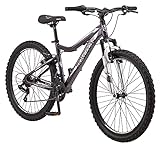
- 6061 aluminum frame with hydroformed tubing
- 21-speed with twist shifters
- 26x2.1-inch wheels
- Light alloy rims
- Linear pull brakes
- Strong riser handlebar with colored end plugs
The Mongoose Flatrock has a light and sturdy frame that can withstand high pressure. This Mongoose model is built to give you a smooth, controlled ride on any terrain.
It embodies the lightness of aluminum and the durability of the hydroforming technique.
The suspension fork absorbs shock well, making rides smooth on patchy roads.
A 21-speed gear with Shimano derailleur offers smooth shifting and a range of gear choices for slopes and descents.
The linear brakes fitted on this bike are effective and reliable. Speed control is accurate, and braking is good even at high speeds.
The rims are made from alloy and are supported by a 2.1 inches wide tire. The lightness of the rims combined with the wide mountain tires makes clearing tricky trails easy.
These features and benefits make the Flatrock the best hardtail under $500 for women. It suits a range of heights and is ideal for riders who value both performance and durability.
Best Entry-Level: Huffy Stone Mountain Bike
No products found.
This bike is an impressive hardtail mountain bike for beginners aside from being a good-looking bike. At its price, it holds up well for mountain bike trails with roots, dips through fine gravel, and dirt.
The 21-speed choices offer smooth gear-shifting and provide a wide array of speeds to choose from – for uphill and downhill rides. The 26-inch tires are also responsive and great for maneuvering.
Not only that but you also get linear-pull brakes which are inexpensive to maintain.
If you want to buy one of the cheapest mountain bikes to start your cycling journey, definitely consider this model. At the time of this update, its price is still under $500. Not only does this bike have a sleek design with its matte finish but it also gives a solid performance.
If you are on a limited budget, the Huffy hardtail offers a solid start to your cycling journey.
What is a Hardtail
A hardtail is one with a front suspension installed at its front wheel.
The suspension is built into the fork, so you might hear it called a “suspension fork” or “air fork.” Some have a lockout—a switch that lets you make the fork stiffer for smooth riding on flats.
Having a lockout means you can adjust the low-speed compression rate of the fork. Decreasing the low-speed compression rate can have the effect of making the fork rigid. When this happens, the suspension mechanism will not have many rebounds or will have no rebound at all. With less or no rebound, pedaling becomes more efficient.
Hardtail vs. Rigid

Rigid mountain bikes have no suspension at all.
They can be harder to ride on bumpy trails but use all your pedal power to move you forward. Hardtails offer more comfort and versatility on uneven terrain.
Hardtails are more versatile than rigid mountain bikes. It can perform well on forests, gravel, and muddy trails. With a lockout, pedaling efficiency on smooth roads is almost as good as that of rigid mountain bikes.
Hardtails and rigid mountain bikes are both cheaper and easier to maintain.
Hardtails can be a bit heavier than a rigid mountain bike, depending on the gears and tires fitted on the bike.
Overall, a hardtail is the better choice if you want to explore various terrain with just one bike.
Hardtail vs. Full Suspension

A full-suspension bike has a front and rear suspension. This makes riding more comfortable since the front, and rear wheels’ impact is minimized by the suspension mechanism.
Riding in technical terrain is a lot easier on a full-suspension than a hardtail.
The downside is that full suspension bikes are more expensive and more prone to mechanical issues. It is also heavier than a hardtail.
Moreover, a full suspension is much more unpredictable and challenging to control. This is because of the rebound when the suspension absorbs the shock.
Pedaling is also less efficient in a full suspension compared to a hardtail.
What to look for when buying a hardtail mountain bike under $500?
Reading bike reviews may make you hesitant about buying a mountain bike under $500.
A lot of experts recommend buying more expensive bikes fitted with excellent components. This can make you think that you can’t buy a good bike at a quarter of the price most people recommend.
But don’t fret.
Much more than the bike’s price, it is more important to look at specific components to know whether the bike is good or not.
So, what if it is under $500?
As long as you have the correct frame size, wheel size, brakes, and gears, then all is well.
Frame size
- Make sure the bike fits you. The right frame size makes riding comfortable and safe.
- Check the distance from the saddle to the handlebar and from the crank to the head tube.
- Brands may label sizes as S, M, L or give measurements in inches. Always check the sizing chart and ask questions if needed.
Wheel size
There are two things to note when choosing the right wheel size.
First, the diameter; second, the width.
Diameter
For adult mountain bikes, the wheel diameter is 26 inches, 27.5 inches, 27.5+ inches, and 29 inches. For children, it ranges from 12 to 25 inches.
Smaller wheels are lighter and more responsive. Larger wheels, on the other hand, are heavier and are more challenging to maneuver.
It is easier to gain speed when using smaller wheels, but overcoming obstacles can be a problem. With bigger wheels, gaining momentum is more complex but rolling over obstacles is easier.
Wheel diameter is affected by the frame and fork size. Most biking experts recommend choosing a wheel diameter that corresponds to your bike frame and fork size.
Width
Bike wheel diameter can range from 1.6 inches to 2.6 inches.
The wider the tire, the more friction it creates. With more friction, there more resistance and grip. This makes wider tires a better choice for muddy and slippery trails.
Thinner tires are lighter and create less rolling friction. It is best to use these tires for long rides where the terrain is smooth and generally dry.
When choosing your bike tire’s width, choose one that fits the terrain you plan to ride at.
Brakes
Mountain bikes can either have disc brakes or rim brakes.
Disc Brakes
In this braking system, braking force is applied on a brake rotor mounted on the wheel hub.
Disc brakes are either hydraulic or mechanical.
Hydraulic disc brakes, hydraulic fluid (usually mineral oil) are pushed through the brake hose and onto to caliper where the pads are. The pads then make contact with the rotor making the bike stop.
In the case of mechanical disc brakes, the braking mechanism is cable activated. When the brake lever is pulled, this causes a tension on the wire that pulls the caliper forcing the pads to make contact with the disc.
Hydraulic disc brakes automatically adjust in case of brake pad wear. Mechanical disc brakes require manual adjustment.
Rim Brakes
In the case of rim brakes, brake pads directly clamp on the wheel rim. This braking force is also cable-activated like that of mechanical disc brakes.
Disc Brakes vs. Rim Brakes
Disc brakes offer more powerful and more consistent braking. It provides reliable braking on any kind of terrain and under any weather condition.
Rim brakes have less braking power. Its performance also decreases when it is splashed with water or mud.
Disc brakes are more expensive but are cheaper to maintain.
Usually, the pads and the rotor are the ones that need replacement. This is cheaper than changing the entire tire, which generally happens with rim brakes.
Replacing your tires happens more often with rim brakes since the rims tend to wear out due to their force. This makes it more expensive to maintain.
Choosing the right brakes is mainly dependent on your choice of terrain.
If you like biking in places where:
- You will likely encounter muddy trails; or
- Have the need to cross rivers,
then, it is safer to get a mountain bike with disc brakes. If not, then going for disc brakes would suffice.
Gears
The number of gears is determined by multiplying the number of the front chainrings to the sprockets’ number on the cassette.
Most modern mountain bikes have 10 to 27 gears.
Having more gears gives you more options in balancing your energy and speed. That is why when choosing your gears, it is vital to think about your fitness and the terrain where you wish to go biking.
If you are not such a strong biker but want to explore mountains and trails, it is best to have more gears. But if you plan to just stay on flats, then having lower gears is not a problem.
Most Commonly Asked Questions
Conclusion on the Best Hardtail Mountain Bikes Under $500
Let me now simplify all the things I have talked about so far. The main point is that there are great hardtails that you can buy at less than $500.
The next issue is for you to keep in mind the following things when choosing your own hardtail:
1) Choose the right bike fit;
2) Choose your tires, brakes, and gears based on:
- Your fitness;
- Your biking skill;
- Your choice of terrain; and
3) Understand the basics of mountain biking.
When you understand the basics of mountain biking, you will discern the right bike for you. With everything said, I consider the Bonafide as the best hardtail under $500. But if your height is not suitable for it, the High Timber is a great alternative.