Best Mountain Bikes Under $500
- Best Overall: Gravity FSX 1.0 Full Suspension Mountain Bike
- Best Alternative: Schwinn High Timber Hardtail Mountain Bike
- Best Value for Money: Mongoose Flatrock Hardtail Mountain Bike
- Best Style: Royce Union RMA Hardtail Mountain Bike
- Best Entry-Level: Huffy Hardtail Mountain Trail Bike
- Best Budget MTB: Hiland Hardtail Mountain Bike
- Best All-Terrain Bike: Mongoose Dolomite Rigid Mountain Bike
When it comes to finding the best mountain bike under $500, I understand that performance, durability, and style are key—especially if you’re a research-driven rider.
If you’re like us, then your mountain biking habit leaves little room for anything else in your life. You need to get out and ride every day or risk losing your mind! But it’s hard when you can’t afford a top-of-the-line $3,000 mountain bike.
Are you looking for the best hardtail mountain bike under $500? Or maybe the best budget full-suspension mountain bike?
Well, with $500 you can still do what the best mountain bike under $1000 can do.
Need a Few Practical Extras for Your Next Ride?
Browse cycling-related clothing and simple bike accessories that may help with comfort, visibility, storage, or everyday riding.
Paid links. As an Amazon Associate we earn from qualifying purchases.
If you’re a beginner, $500 is a good starting point to find the best beginner mountain bike that suits you.
We reviewed 7 of the best mountain bikes under $500 so that no matter what kind of rider you are or how much money is in your wallet, there’s an affordable option available for everyone!

12,687
Customer Reviews

19
Testing Hours

7
Tested Products

12
Sources Researched
- Best Mountain Bikes Under $500
- 7 of the Best Mountain Bikes Under $500
- 1. Best Overall: Gravity FSX 1.0 Full Suspension Mountain Bike
- 2. Best Alternative: Schwinn High Timber Hardtail Mountain Bike
- 3. Best Value for Money: Mongoose Flatrock Hardtail Mountain Bike
- 4. Best Style: Royce Union RMA Hardtail Mountain Bike
- 5. Best Entry-Level: Huffy Hardtail Mountain Trail Bike
- 6. Best Budget MTB: Hiland Hardtail Mountain Bike
- 7. Best Fat Bike: Mongoose Dolomite Rigid Mountain Bike
- What to Consider for Mountain Bikes Under $500
- Types of Mountain Bikes
- Most Commonly Asked Questions
- Conclusion on the Best Mountain Bikes Under $500
7 of the Best Mountain Bikes Under $500
1. Best Overall: Gravity FSX 1.0 Full Suspension Mountain Bike
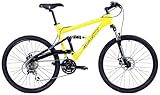
- Welded 6061 aluminum frame
- 26 by 2.1-inch tires
- SunTour long travel suspension fork
- SunTour crankset
- Shimano front and rear derailleur
- 24-speed Shimano EZ Fire trigger shifters
- Mechanical disc brakes
The Gravity FSX 1.0 stands out as a well-rounded option if you’re seeking a bike that can handle both urban commutes and moderate off-road trails.
In my experience, the dual suspension system helps smooth out bumpy rides without compromising energy transfer, while the disc brakes offer consistent performance in wet or muddy conditions.
This model could be a strong candidate for riders looking for an overall balanced ride at a budget-friendly price.
2. Best Alternative: Schwinn High Timber Hardtail Mountain Bike

- 17-inch steel/aluminum frame with 12 color options
- 24, 26, 27.5, 29 inches wheel size
- 21-speed twist shifter
- Mechanical disc brakes
- Front suspension type
- Quick release seat post
The Schwinn High Timber offers a reliable alternative for those who value simplicity and ease of maintenance. I found that its front suspension fork effectively cushions impacts on urban roads and light trails.
Its 21-speed system is versatile enough for various terrains, making it a practical choice if you’re testing the waters in mountain biking.
This bike might be especially appealing for beginners who appreciate a straightforward, no-fuss design.
3. Best Value for Money: Mongoose Flatrock Hardtail Mountain Bike
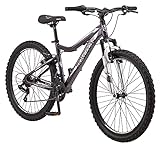
- 6061 aluminum frame (Available sizes: 14.5, 16, or 18)
- 26-inch tires
- Front suspension fork
- 21-speed twist shifters
- V brakes
The Mongoose Flatrock balances affordability with a feature set that could meet the needs of both novice and intermediate riders.
The different frame size options mean you can select a bike that feels tailored to your build, and the 21-speed system offers plenty of versatility.
In my testing, this bike delivered consistent performance on both city streets and less demanding trails, making it a sensible option if you’re budget conscious without sacrificing functionality.
4. Best Style: Royce Union RMA Hardtail Mountain Bike
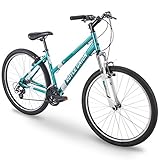
- Lightweight aluminum frame (different sizes available: 17, 20, 22-inch frames)
- 27.5-inch tires
- Front suspension fork
- 21-speed with twist shifters
- Linear pull brakes
At first glance, the bike looks awesome and well-made. Plus it looks sleek with its matte finish. When we tested it, we found the bike very responsive and the brakes snappy.
The linear-pull brakes allows you to enjoy rolling over rough terrains with reliable stopping power. With a twist, you can stop anytime you want.
It’s an awesome bike for park and rocky trails. If you prefer the efficiency of a hardtail coupled 21-speed options, the Royce Union RMA is for you. Overall, it’s a solid bike for your money.
For those who appreciate a bike that not only performs well but also looks great, the Royce Union RMA might catch your eye.
5. Best Entry-Level: Huffy Hardtail Mountain Trail Bike
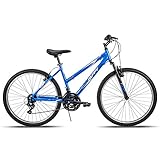
- Aluminum frame (available in 17, 18, 20-inch frame size options)
- 26 by 1.95-inch tire size
- Front suspension
- 21-speed Shimano drivetrain
- Linear pull brakes
The Huffy Hardtail Mountain Trail Bike is a solid introduction to the world of mountain biking.
With its straightforward design, this model is designed to minimize maintenance while still providing a comfortable ride for casual trails.
I found it particularly suitable for those who are just starting out, as it delivers reliable performance without the complexity or cost of higher-end models.
6. Best Budget MTB: Hiland Hardtail Mountain Bike

- Aluminum frame
- 26/27.5-inch quick-release wheels
- Lockout front suspension fork
- 21-speed shifter with Shimano rear derailleur
- Double disc brakes
At a glance, this Hiland 27.5 looks nice and seems sturdy as an entry level mountain bike. For its price, it packs a lot of neat features. The bike is smooth and brakes and shocks worked great. When we had it for a test ride, the ride was smooth and stable. It also did well on off-road for its price.
What makes this bike great are its hydraulic brakes and 27 speeds to choose from. At its current price, this bike is a steal. Still anyone planning to do actual mountain biking may experience the need for more durable components for hard use like jumps, rocks, etc.
In general, this affordable bike is perfect for commuting, light off-road, and mountain trails.
7. Best Fat Bike: Mongoose Dolomite Rigid Mountain Bike
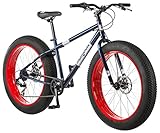
- Steel frame
- 26 by 4-inch fat tire size
- 7-speed Mongoose twist shifters
- Mechanical disc brakes

The Mongoose Dolomite with its fat tires is built for the all-terrain ride, including snow, mud, dirt, sand, or city roads. The fat tires compensate for the absence of suspension on this bike, still giving a comfortable ride.
Although built with a steel frame, the rims are made of lightweight alloy to keep the weight down. You’ll be surprised how the bike does not feel slow as it looks. The build of the bike is simple and obviously best suited for beginner and recreational cyclists who fancy a fat-tire bike below $500.
In general, the Mongoose Dolomite is designed for riders who need a bike capable of tackling a variety of terrains.
What to Consider for Mountain Bikes Under $500
Most mountain bikes under $500 are entry-level bikes. For a bike under $500, look for an aluminum frame. Steel can be a great and cheaper material but they are heavy. At this price range, it’s best to avoid steel frames. Except for the Mongoose Dolomite, all the bikes in this review have an aluminum frame.
At $500, you’ll likely have a bike with 24-speed or 21-speed and mechanical disc brakes. Mechanical disc brakes are all you need for stopping power unless you will be riding downhill a lot. Linear pull brakes can also save you a lot of money especially if you only plan to do light off-road riding.
When it comes to tires, it depends on how much time you’re likely to spend riding off-road. But it’s best to consider knobby tires for extra grip and traction.
Suspension forks are also a plus. For light mountain trails, the front suspension fork is enough to give you a comfortable ride. If you will be doing more jumps and bumpy trails, consider buying a dual suspension bike but at a higher price.
A cheaper rigid fork (no suspension) bike can also be a good choice. By buying a rigid bike, the money saved can be used to upgrade the bike to improve its performance. If you choose a rigid bike, consider buying a bike with fat tires. The fat tires act as shock absorbers.
Types of Mountain Bikes
Suspension System

Rigid
“Rigid” mountain bikes have no suspension. So they are usually less expensive and easy to maintain. Most rigid bikes have fat tires. Riders who prefer rigid bikes find that the fat tires and low tire pressure provide all the needed absorption due to bumps in the trail.
Hardtail
These mountain bikes have a suspension fork in the front but not the rear of the bike. The front fork helps absorb impact. These types are usually less expensive bikes compared to full-suspension bikes. They also have fewer moving parts, so they get less maintenance. Usually, the front fork of a hardtail has a lock-out feature turning the bike into a fully rigid bike when desired.
Except for serious downhill trails, hardtails are best for cross-country rides because bikers get a more direct transfer of power between the rear tire and the pedal stroke. They are also a good choice for all-mountain trails.
Full suspension
With the help of the front and the rear absorbing more impact, full-suspension bikes are created to drastically reduce the rider’s impact. This, in theory, makes a more enjoyable ride.
On the one hand, you lose some of the energy transfer when using a full-suspension bike uphill. This is why most full-suspension rigs have lock-out features for the rear suspension to allow a more efficient transfer of power and better climbing. As such, full-suspension bikes are best for bumpy downhill rides.
Wheel Size
The wheel size of a bicycle is the diameter of its wheel.
Mountain bikes for kids usually have 24 inch-wheels to accommodate the children’s shorter legs.
In contrast, 26 inches is the wheel size popular for its responsiveness and control.
On the one hand, 29 inches are usually heavier and slower to accelerate but can cover more terrain easily. Generally, they provide excellent grip making trail obstacles more manageable.
29ers are very popular for cross-country rides.
27.5 inches is the middle ground between 26 inches and 29 inches; it can roll over terrain easier than the 26ers and is more maneuverable than the 29ers. 27.5ers and 29ers can be found on both hardtail and full-suspension bikes.
Brakes
When buying a mountain bike, always check on the brake system. Cheaper bikes have linear v-brakes while more expensive bikes have disc brakes.
Linear v-brakes
Linear v-brakes are more affordable to repair and maintain than disc brakes. Though it provides a strong stopping force, it is not as consistent as disc brakes.
Disc brakes
Disc brakes are either mechanical or hydraulic disc brakes. Mechanical disc brakes require less maintenance and are less expensive. While hydraulic disc brakes require higher maintenance at a higher price.
In terms of efficiency, hydraulic disc brakes provide a better and powerful stopping force than their mechanical counterpart. However, if you will not be doing mostly downhill rides, mechanical disc brakes are enough for your riding needs.
Gears
To get your bike’s total number of speeds or gear combinations, multiply the number of rear cogs and front sprockets. For example, three front sprockets and seven rear cogs will give you 21 speeds.
How do you know what gear to use?
- Use a lower gear when climbing uphill. A lower gear gives you a slower speed but provides more traction. Make sure you shift down your gear for a smooth ride.
- Use a higher gear when riding downhill. With a higher gear setting, you get smoother pedaling but less traction on the ground. Perfect for downhill rides.
Most Commonly Asked Questions
Conclusion on the Best Mountain Bikes Under $500
With everything said, my top pick for mountain bikes under $500 is the Gravity FSX 1.0 for its full suspension system for versatility and comfort. Then the Schwinn High Timber as best alternative for its great design and excellent capability on mountain trails. For the best value for money and best for beginners and cross-country trail riding, you won’t regret getting the Mongoose Flatrock.
But if you are looking for a different adventure, why not consider BMX bike riding?
Have fun riding!