Key Takeaway:
Mountain biking vs road biking boils down to your goals: off-road delivers higher intensity, better bone health, and adventure; road delivers speed, efficiency, and a smoother commute—balance injury risks, maintenance, and budget when choosing.
Mountain biking vs road biking is a question every cyclist asks: do you crave rugged trails or smooth tarmac?
This choice means balancing adventure with eco-friendly commuting, all while weighing gear costs, maintenance needs, and injury risks. Many enthusiasts dream of owning both bikes, but reality often limits options.
Need a Few Practical Extras for Your Next Ride?
Browse cycling-related clothing and simple bike accessories that may help with comfort, visibility, storage, or everyday riding.
Paid links. As an Amazon Associate we earn from qualifying purchases.
Each cyclist has their priorities, style, and needs in riding. Most people use cycling as a cardio exercise, some to lose weight, and others find it as a hobby. It’s just a matter of goal, style, and preference.
First, here’s the summary:
| Aspect/Category | Mountain Biking (MTB) | Road Biking |
|---|---|---|
| Terrain and Riding Conditions | Rough terrains, trails, unpredictable conditions. | Smooth roads, consistent grades, predictable conditions. |
| Bike Construction and Design | Durable, versatile, built to handle challenges. | Sleek, aerodynamic, built for speed. |
| Intensity and Workout | More intense due to varying terrains and obstacles. | Consistent, can cover longer distances. |
| Pros | Versatility, intense workout, adventurous. | Faster speeds, efficient for commuting, consistent workout. |
| Cons | Requires more maintenance, potential for injuries. | Limited to roads, potential traffic hazards. |
Now, we will discuss the details of each cycling system to help you decide which to go for.

Mountain Biking Advantages

One With Nature
Mountain biking gives you lots of opportunities to ride on natural trails. It’s not just about adventures, but also a chance to bond with nature. MTB allows you to relax from the daily hustle and bustle of city life.
Traffic and Safety
Some cyclists prefer off-road riding because aside from the fact that you’d get fresher air, you won’t also have to deal with traffic jams and safety. In 2016 alone, almost 840 American bicyclists died from crashes with motor vehicles. Although there’s also a couple of accidents linked to mountain biking, it’s lesser compared to road biking.
Design
Compared to a road bike, MTBs are more versatile and durable. You can ride your MTB just about anywhere even on roads! MTBs are designed to provide stability, comfort, and balance. So if that’s what you’re looking for, then get an MTB, but we suggest that you get an MTB that suits your body size.
More Intense Workout
If you want to know which cycling system can give you a more intense workout, the straight answer is- MTB for sure. When off-road riding, even if you don’t put any power into the pedals, your heart rate will surely spike because you’ll have to deal with bursts of speed, vibrations, turns, and obstacles that activate more muscle groups. Plus, MTBs are typically heavier causing you to put more effort and power when pedaling.
Culture
Each cycling system has its own culture too. We can’t tell which has a better culture, but you can decide where you’d fit in based on your personality. Generally, MTB riders are more informal, relaxed, and adventurous. They prioritize bonding and experience rather than racing and competition.

Mountain Biking Disadvantages
Hard to Wash
Riding off-road means dealing with dirt, dog poop, dirty goggles, and mud! After every ride, you have to wash your bike to keep it running well.
Expensive Gears
Maintaining the extra components and materials that your MTB has can be a little costly. And there’s a very limited option for good quality mountain bike parts, so it’d be hard to do upgrades.
Weight
MTBs are heavier because they have more components added to them. Because of this, MTBs are generally less aerodynamic compared to road bikes. Although you have the option of buying a lighter MTB, you’d have to extend your budget for a lighter bike.
Body Pain
Riding off-terrain for hours can cause you back pains, knee pain, and other body injuries. Many bikers experience body pains when they spend a lot of their time on the bike.

MTB Cost
A decent MTB can cost you 1000-1500 dollars- and that’s just the bike’s body. You will also have to buy your gears, clothing, and other components for an optimal riding experience. Caring for and cleaning your MTB after every ride can reduce the cost of repairs and maintenance on your bike.
Road Biking Advantages

Lightweight and Better Speed
If you’re all about speed then go for a road bike! Your speed is guaranteed with its lightweight materials and components design. Road bikes are perfect if one of your priorities is racing, triathlon, and touring.
Efficient
Road bikes are made for speed where cyclists can tuck in and ride fast. You’ll also have multiple hand position options to stay comfortable during long rides, unlike MTBs that only use 1-2 hand positions.
Environmental Friendly
Worried about your carbon footprints? Then pedal your way to work using your road bike. There are just so many cars on the road emitting smoke that can bring significant damage to our ozone layer. Shift to a sustainable lifestyle if you want to help the environment. It will surely make a big difference!
Lesser Gears
You can ride a road bike without all the gears that an MTB requires and can still perform!
Road Biking Disadvantages
Dangerous Drivers
Dangerous drivers are everywhere! Cycling accidents are also increasing not only because of irresponsible drivers but also because of the lack of cycling lanes and trails.
Bike Theft
Every 30 seconds, a road bike goes missing in the US. This problem has been growing since the pandemic, and unfortunately, even locking your bike doesn’t work anymore!
Bikes are huge investments, so protect them by making sure you have your bike serial number handy.
Road Hazards
Road bikers deal with road hazards all the time. There can be weather hazards like ice, snow, sharp stones, and mud that can puncture your tires, especially at night! So when riding in grave weather conditions, make sure you bring all the essentials like your pumps.
Body Pains
Riding a road bike also means considering the bike fit, riding position, and warm-ups. Without considering all these, you might suffer from body pains or long-term injuries. In line with this, it’s important to equip yourself with the right gear including the best road bike helmet and the best waterproof cycling gloves.
Road Bike Cost
Road bikes cost more than MTBs. Road bikes use high-quality materials that can cost you up to $13,000 to $15,000. For starters, you can buy a cheaper bike at $900, but you can also purchase a decent second-hand bike not cheaper than $300.
These bikes are built for different purposes, and there are PROS and CONS to each style of biking. The only way you will know which can best cater to your needs is by asking yourself about your priorities, what you will use the bike for, when you will be riding, and your budget.

Picking the Right Bike for Your Goals
Fitness Fanatics: Crave Intensity?
Mountain biking is your go-to! Riding through uneven terrains, dodging obstacles, and tackling steep inclines will give your muscles a workout they won’t forget.
Daily Commuters: Need Efficiency?
For those who pedal to work or around town, road biking is the champion. Its design is all about smooth, fast rides on paved roads, making your daily commute a breeze.
Adventurers at Heart: Seek Exploration?
If the call of the wild beckons you, mountain biking lets you answer. Dive into off-road trails, explore nature up close, and satisfy your adventurous spirit.

Statistics and Facts: Mountain Biking vs. Road Biking
Incidence and Severity of Injuries
Research shows MTBers are admitted to hospitals more often, but road cyclists sustain more severe injuries when they crash: 28.6% of road cyclists needed urgent care (triage 1–2) vs. 21% of MTBers, and 26.5% of road cyclists required surgery vs. 18% of MTBers. The median Injury Severity Score (ISS) is higher for road cyclists (6) than MTBers (4).
Head and Spinal Injuries
Severe head injuries (AIS 3–6) occur in 14% of road cycling crashes vs. 1% in MTB; spinal injuries AIS ≥2 are also more common in road cycling. Another study found head injuries in 16% of road accidents vs. 6% in trail biking, while thoracic trauma is higher in trail riders (7% vs. 2%).
Injury Mechanisms
Road cyclists are often injured in motor-vehicle collisions (>30% of cases), whereas MTBers crash into obstacles like trees or lose control on technical terrain.
Common Injury Types
Across both, lacerations/abrasions (64%), upper extremity fractures (26%), head injuries (9%), and thoracic trauma (6%) dominate.
How Much Effort Are We Talking About?
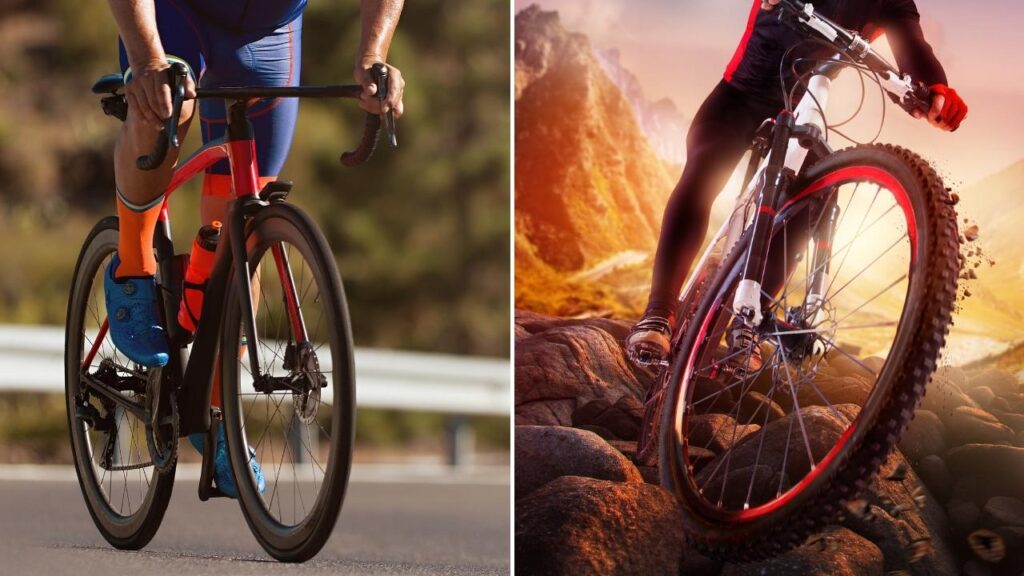
Both biking styles demand effort, but in different ways:
- Mountain Biking: Requires bursts of energy, especially when navigating rough terrains or climbing steep trails.
- Road Biking: It’s more about endurance. Long stretches of road can be covered at consistent speeds.
But remember, factors like the steepness of your path (elevation gains) and the type of ground you’re on (grades and terrains) can change the game. A flat forest trail might be easier than a steep city road!
Bone Health and Physical Demands
Bone Mineral Density (BMD): Competitive MTBers show higher BMD at the proximal femur, lumbar spine, and total body compared to road cyclists and active controls, indicating an osteogenic (bone-building) stimulus unique to off-road riding.
Osteogenic Stimulus: The jumps, drops, and varied terrain in MTB engage bone remodeling more than the steady loads of road cycling.
Comparative Summary Table: Mountain Biking vs Road Biking
| Aspect | Mountain Biking (MTB) | Road Biking |
|---|
| Injury Frequency | Higher hospital admissions | Lower admissions, more severe |
| Injury Severity | Lower ISS, fewer surgeries | Higher ISS, more surgeries |
| Head Injuries | Less frequent, less severe | More frequent, more severe |
| Bone Mineral Density | Higher BMD | Comparable to recreational activity |
| Muscular Demand | Higher demand, lower RPMs | Lower demand, higher RPMs |
| Common Injury Causes | Object collisions, loss of control | Motor vehicle collisions |
The Final Decision: What Suits YOU?
When it’s time to pick, think about:
- Your Goals: Are you aiming for fitness, transportation, or adventure?
- Your Location: City streets or countryside trails? Your environment matters.
- Your Budget: High-end models or something more pocket-friendly?
- Your Gut Feeling: Sometimes, it’s just about what feels right.
And here’s a golden tip: Try Both! Spend some time on both types of bikes. Your personal experience will be the best guide in making a choice.
References
Escapecollective.com. (2024, April 19). Which is more dangerous: road cycling or mountain biking? https://escapecollective.com/which-is-more-dangerous-road-cycling-or-mountain-biking/
Barry, D. W., Kohrt, W. M., & Wolfe, P. (2002). Bone mineral density of competitive male mountain and road cyclists. Medicine & Science in Sports & Exercise, 34(6), 1077–1086. https://pubmed.ncbi.nlm.nih.gov/11792598/
Gaulrapp, H., Weber, A., & Rosemeyer, B. (2016). Cycling injuries in Southwest Colorado: A comparison of road vs trail riding injury patterns. Wilderness & Environmental Medicine, 27(2), 282–290. https://pubmed.ncbi.nlm.nih.gov/27010741/